
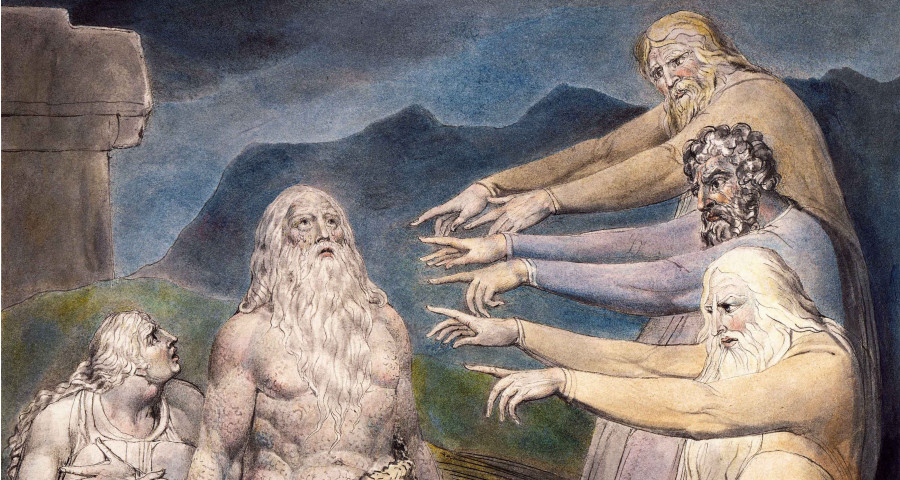
In his Pulitzer Prize-winning book On Human Nature, eminent biologist E.O. Wilson asks us to recall ‘how God lashed Job with concepts meant to overwhelm the human mind’ in Job chapters 38-41, with questions like:
Have you descended to the springs of the sea or walked in the unfathomable deep?
Have the gates of death been revealed to you?
Have you ever seen the door-keepers of the place of darkness?
Have you comprehended the vast expanse of the world?
Come, tell me all this, if you know.
While poor Job can only stammer out a confession of his ignorance, Wilson says we are today in a very different position. Our answer, by contrast, is:
yes, we do know and we have told. Jehovah’s challenges have been met and scientists have pressed on to uncover and to solve even greater puzzles. The physical basis of life is known; we understand approximately how and when it started on earth … Molecular biologists have most of the knowledge needed to create elementary forms of life. Our machines, settled on Mars, have transmitted panoramic views and the results of chemical soil analysis. Could the Old Testament writers have conceived of such activity? And still the process of great scientific discovery gathers momentum.
He wrote that in 1978. The nearly fifty years since have witnessed further techno-scientific marvels like the human genome project, the construction of the international space station, the eradication of smallpox, and the rise of personal computers, the internet, smartphones, and artificial intelligence. Leaving aside the Old Testament writers, I wonder if even E.O. Wilson conceived he would see such things in his lifetime.
But it would also be fair to say there are things Wilson’s list neglects to mention: our age is not just one of bionic ears and black hole photography, but climate instability, social media addiction, and drone warfare, too.
In the case of our ecological crisis, we might make a further tragic observation: while our modern technologies are apparently powerful enough to create problems like microplastic and PFC pollution, species extinction, desertification, and global warming, they have so far shown themselves much less successful at resolving them.
Whether we blame the technology or merely our use of it, this wound in humanity’s relationship to the wider world suggests that we are either incapable or unwilling to wield our technological powers consistently for the good of creation, including ourselves.
This three-article series will argue that E. O. Wilson correctly intuits a connection with the book of Job when considering our techno-scientific accomplishments. Indeed, Job has much to say about both nature and human nature as well as—perhaps surprisingly—technology and the motive for control it represents.
Taking our lead from Job, we will explore the human place in and relationship to the rest of God’s creation, as well as our chief means of influence over it: technology. The rest of this article will briefly outline some of the key anthropological and ecological insights from Job which will lay the foundation for our later discussion. But first, just a few words on Job as a text before we dive in.

Job has much to say about both nature and human nature as well as—perhaps surprisingly—technology and the motive for control it represents.
What kind of text?
Among artistic literary works in the Bible, Job is arguably the pinnacle: ranked by Milton alongside the epics of Homer and Virgil, Job has been rightly regarded for millennia as a jewel of Hebrew philosophical poetry. It’s not an easy text to get a handle on, though, and interpreters both ancient and modern are divided, arguing over its meaning on fundamental points. This is understandable, perhaps, for the main body of the text is itself an argument, and it is somewhat difficult to tell who—if anyone—is right. Job’s Friends certainly say much which is true and sounds appropriately pious, while Job’s own bitter complaint against God at times borders on blasphemy. Yet in the end God vindicates Job and denounces the speeches of his companions… why?
For most of us, of course, the problems begin far earlier than that, for in chapters one and two we witness God giving Job’s angelic adversary (the śāṭān) permission to ruin his life. Without getting too deep into it, let me suggest that this is supposed to rankle: this is how the story first gets a hold on us. Without being stirred up and a bit bewildered we will not read it aright.
But did it really happen? The text seems deliberately evasive: in 42 chapters we are given almost no hard details to locate it. I don’t think the Job poet was interested in answering this question, not to mention the theological issues raised if it were historically true. Rather, just as mythic tales contain truth at a deeper level than plain facts, I agree with Christian storyteller and mythographer Martin Shaw when he reads ‘In the land of Uz there lived a man’ as an ancient Hebrew way of saying ‘Once upon a time…’

‘What is humankind, that you make so much of them?’
Moral creatures
The first thing the text affirms about us is that we are moral beings: Job is introduced as someone of unimpeachable character, and it is this fact—and the debate over it between both heavenly and human characters—which gets the whole drama moving in the first place. With only the possible (but unclear) exception of angels, humans are uniquely spoken of as moral creatures, able to use their freedom for wilful good or evil. God’s interest in us includes interest in this dimension, for he even singles Job out for the Adversary’s attention as a point of apparent satisfaction, even pride: ‘Have you considered my servant Job? There is no one on earth like him…’ (1:8).
We are not the centre
Yet despite this special attention, when God finally speaks to Job in chapters 38-41 humans are noteworthy chiefly by their absence. Instead, while God waxes ever more lyrically about the cosmos and the many other inhabitants of Earth, the existence of humans is acknowledged only indirectly and in passing. Job scholar Norman Whybray summarises the impression of both casual readers and scholars when he concludes that the general omission of humans here ‘with their obsession with their own problems and their demands … cannot but be intentional’. Apparently, God is trying to pull Job’s perspective wider than merely human concerns, to consider also the stars, the depths of the sea, and Behemoth ‘whom I made along with you’ (40:15). Despite his care for us, we are not the definitive centre or measure of his creation.
When God finally speaks to Job ... humans are noteworthy chiefly by their absence.
Limited and dependent
Upon first reading, this can sound like the same point Job’s companions have been rebuking him with all along. God’s mysteries are higher than heaven and deeper than the depths, says Zophar to Job, so ‘what can you know?’ (11:8). Or ‘How great is God—beyond our understanding!’ (Elihu, 36:26). To be fair to Job, he never denies these claims: he has no doubt of humanity’s ultimate incomprehension of God or his matchless power, except for him these facts are a source of despair and dread rather than consolation:
You snatch me up and drive me before the wind;
you toss me about in the storm.
I know you will bring me down to death,
to the place appointed for all the living. (30:22-23)
Indeed, death is affirmed by all as proof of human limitation before God. Our lives are like a breath, our days on earth are ‘like a fleeting shadow’ (14:2) and we would perish the instant God ever chose to withdraw his Spirit. In God’s hand is ‘the life of every creature, and the breath of all humankind’ (12:10). Even the mightiest rulers and nations are powerless before him.

Mortals, born of woman,
are of few days and full of trouble.
They spring up like flowers and wither away;
like fleeting shadows, they do not endure. (Job 14:1-2)
Deepening into mystery
If this is all true and agreed among Job and his Friends, then what do God’s speeches add to the dialogue? This is a much-debated question, but I submit that the answer cannot be merely to demonstrate the futility and presumption of human speech about the deep things of God and his world, as this is never in contention. Besides, if God fully approved of the responses of Job’s Friends then why is he so angry with them, requiring Job to make intercession on their behalf (42:7-8)?
There is more going on here, but what? Firstly, while there is real rebuke in his words, it’s not at all clear that God is bullying Job into silence. If that was the goal, it comes after only two chapters, why go on? Additionally, while God’s tone is hard to discern here, it’s clear enough that—though awash with irony—his favoured mode of responding to Job is the question: where were you… can you… do you know? This suggests that God is not simply trying to close Job down, as the Friends were, whose few, short questions tend to be only different ways of saying, what do you know? Shut up. God’s questions, while superficially similar, come laden with exquisite poetic detail and extended imagery: he’s trying to open Job up—to see or appreciate something anew, to engage his imagination toward some sort of reorientation. When God speaks, the whole cosmos comes rushing in with all its immensity, particularity, and personality.
To what end? I cannot improve on the opinion of Rudolf Otto, who argues that God’s aim here is to convince Job, not only to convict him: ‘to utterly still every inward doubt that assailed his soul.’ This is not achieved by simply overpowering him, or even by supplying the rationally acceptable formula my ways are higher that your ways. Rather, God’s response turns ultimately on
something quite different than anything that can be exhaustively rendered in rational concepts, namely, on the sheer wondrousness that transcends thought, on the mysterium presented in its pure, non-rational form … it mocks at all conceiving but can yet stir the mind to its depths, fascinate and overbrim the heart.
Or, in the words of another scholar, instead of further argument, God seeks to captivate Job—‘to draw him into a “spiritual Copernican revolution” of wonder’—to settle him in mystery which is greater and other than simple ignorance.
Job 28: Homo sapiens?
The final strand of Joban anthropology worth mentioning here comes to us in the semi-independent poem of chapter 28 which marks a sort of reflection point in the discourse. The poem centres on the seeming inaccessibility of wisdom to human beings, or indeed to any creature. However, many scholars have noted something of a tension here due to the poet’s extended description of a quintessentially human technological activity: mining. They observe how the language in verses 1-11 is curiously elevated, seeming ‘more appropriate for divine activity’. That is, mortal accomplishments—putting an end to the darkness, searching its farthest bounds, overturning the mountains—are somewhat blurred here with those of God to an unnecessary—and therefore apparently deliberate—extent (cf. 38:4-12; 26:10). Certainly, our technical skill seems to set humankind apart from eagle and the wild beasts; we even call ourselves sapiens—wise ones—and Job 28 indeed hints that we alone mimic God in this way. In the wider poem, of course, this section serves primarily to underline the main point: though humans undertake such marvellous activities, venturing deep and far to uncover the earths secrets, even they cannot discover wisdom. Still, it is a curious inclusion, the significance of which we will return to in the next article.

Mortals put an end to the darkness;
they search out the farthest recesses
for ore in the blackest darkness. (Job 28:3)
The place and value of the non-human in Job
Interest in the ecological implications of Job has risen notably in the last half-century, with much work being done in this area. Let me summarise just three key insights.
Likeness among created things
Read Job and you might be struck just how many times the speakers reference plants, animals, and other natural phenomena. By my count, across chapters 3-30 all but chapter 23 contains at least one such reference, with most chapters making use of direct analogies with the non-human world. This is telling, for the language we use—particularly the images we employ—is significantly shaped by the things we are familiar with and engaged by: our world and our words are intimately related. Moreover, the persistence of natural analogies in the central chapters of Job is suggestive not only of familiarity but also of a sense of affinity with other created things. That is, to speak of one thing in terms of another—even to express how they are unlike—one must first feel that they are in some way akin: that they may be spoken of in the same terms. The very possibility of analogy assumes a common core to creation. To take just one example, observe where Job’s mind reaches to express his anguish that his friends have proved faithless:
my brothers are as undependable as intermittent streams,
as the streams that overflow
when darkened by thawing ice
and swollen with melting snow,
but that stop flowing in the dry season,
and in the heat vanish from their channels. (6:15-17)
When God speaks, the whole cosmos comes rushing in with all its immensity, particularity, and personality.
The creation communicates the Creator
If there is a connection between humans and other beings in creation, there is also something similar to be said of God. Throughout the book, his attributes are often listed with reference to his works, and the forces of the Earth are spoken of as instruments of his action. Job represents God’s immense power and wisdom by recourse to his creation and sustainment of the world, while the Friends—without disagreeing—further claim in various ways that people’s virtue or wickedness directly affects the disposition of the created world toward them, resulting in either blessing or disaster (cf. Lev 26). While this sense of clear and reliable retribution is by no means something endorsed by the book as a whole—we are not to understand Eliphaz, Zophar, or Bildad as sure theological guides—what is worth observing here is the (true) conviction they share with Job that it is ultimately God who determines what happens in his world. As Elihu relates:
God’s voice thunders in marvellous ways;
he does great things beyond our understanding.
He says to the snow, ‘Fall on the earth,’
and to the rain shower, ‘Be a mighty downpour.’
So that everyone he has made may know his work,
he stops all people from their labour. (37:5-7)
Thus, even if what we observe in the regularities and marvels of the world are only ‘the outer fringe of his works’ (26:14), they remain real, if incomplete, reflections of the mind behind them.

Creation’s value beyond human use
We have already seen that God’s speeches move Job away from considering the world in purely human terms. More than this, though, in chapters 38-41 we experience God’s immense delight in his creation on its own terms. Unlike Elihu, who speaks exclusively of the world as perceived by people, God’s speeches take us far beyond the reach of human awareness in both space and time. With Job we are called to contemplate the springs of the sea and the recesses of the deep, the abode of light, the gates of death, the foundations of the earth, and the making of the world. With Elihu we considered the fall of snow—which we may observe—but God calls us to imagine the storehouses where he keeps it, somewhere beyond sight. Again and again, God shows himself interested in the vast territories of his world unknown and untraveled by humans: regions which serve no human purpose. The reasonable conclusion is that his joy in these works of his is because they are good and valuable to him for their own sake.
Similarly, about animals Elihu has precious little to say, while God cannot seem to spend enough time in intimate attention with each one. Notably, most of the animals detailed are both wild and unclean according to Israel’s purity laws, yet God’s joy and interest are undiminished. Some animals, like the ostrich, are not just completely useless to humans, they are a total enigma:
She lays her eggs on the ground
and lets them warm in the sand,
unmindful that a foot may crush them,
that some wild animal may trample them.
She treats her young harshly, as if they were not hers;
she cares not that her labour was in vain,
For God did not endow her with wisdom
or give her a share of good sense.
Yet when she spreads her feathers to run,
she laughs at horse and rider (39:14-18).
Why on earth did God create such a ridiculous creature? What could it possibly be good for? We might ask something similar of Behemoth, or Leviathan. The latter is, if anything, a danger and a terror to humans, yet God seems to revel all the more in his power which only he can hope to control. As Job expert, Kathryn Schifferdecker, remarks, the divine speeches bring us to the unavoidable conclusion that ‘the world exists for the sake of its Creator’ apart from any human knowledge, interest, or use.

Next time…
This article has outlined the very basics of the anthropological and ecological perspective of the book of Job. The next articles in this series will begin to apply these insights to our unfolding eco-crisis which has been made possible by modern technology.
How can we cultivate the same delight, interest, and loving attention God shows toward his world? What are our proper boundaries as technological creatures in an age of ever-receding technical limits? Can ‘mystery’ today mean anything other than blank spaces on our map? Can we keep our tools from remaking both nature and human nature in their own image? These are the kinds of questions to which we will turn.