If you’re a lover of wild animals, I’m afraid I have some troubling news. According to a recently published study, in the year 1850 the amount of wild mammals—measured by mass—compared with the mass of all humans plus our domesticated mammals (cattle, sheep, pets, etc.) was about half/half – about 200 million tonnes each.
By 2025, however, wild mammals accounted for just 5% of the total. That means 95% of all the mass of mammalian life on earth is now found among humans and animals bred by humans for human purposes. Globally, farmed pigs alone weigh as much as all the whales, dolphins, seals, and sea otters in the world combined.
Importantly, this is not just a decline in the relative amounts: while the human side has increased dramatically, the mass of wild mammals has also decreased by almost three quarters in the last 175 years.
Now, if you find measuring animals by mass a bit strange I’m with you there, but nevertheless I find this statistic heartbreaking. But, if a world where 95% of all mammals are either us or ours seems amiss to you too, the question is: why? And when does it become a problem? Is there some perfect ratio which allows for human flourishing without squeezing the rest of creation into the few corners we have left? In an age when we have such a dramatic ability to order the world for our benefit at the expense of our fellow creatures, can we—and how can we—observe limits?
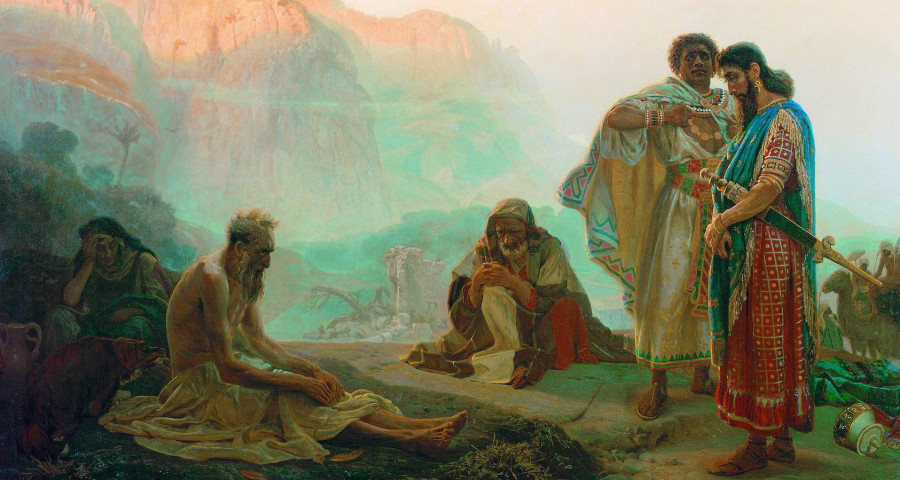
This is the second article in a series reflecting on the book of Job and the proper relationship between humans, technology, and the rest of creation. The previous article offered some basics of an anthropological and ecological reading of Job. This article will focus on the need for limits regarding technology in the light of the immense power it grants us over the material world.

In an age when we have such a dramatic ability to order the world for our benefit at the expense of our fellow creatures, can we—and how can we—observe limits?

Last time…
While Job is most commonly associated with the question of human suffering, it’s perhaps less well known as a key source of biblical reflection on creation and humanity’s place within it. In the previous article, we saw how the book identifies us as creatures both like and un-like others God has made: we share in the frailty and dependence of all flesh, yet we also possess moral and technical capacities which mark us out as unique, even god-like. As we saw in Job 28, things like rope, a pick, and a shovel allow humans to do remarkable things that no other animal does: we mine the depths of the earth and seek out its hidden treasures. Moreover, throughout the whole poetic dialogue Job and his friends demonstrate their moral and rational nature as they debate about causes and effects, rights and wrongs. Unlike other creatures, humans naturally seek to lay hold of the world with both our hands and our minds, while God holds us accountable for our freedom to act.
Yet while Job and his companions are mostly focussed on their own concerns, God cares about a far larger sphere: the divine speeches at the end of the book are the longest unbroken discourse on the creation in the entire Bible and emphatically demonstrate that the God of Abraham, Isaac, and Jacob is also the God of wild places and wild animals too. He not only brings forth the constellations in the sky and sends rain on unpeopled lands, but he also tenderly counts the months until the deer and mountain goat bear their young, hunts prey for the lioness, and revels in the strength of Behemoth and Leviathan.
Look at Behemoth,
which I made along with you
and which feeds on grass like an ox.
What strength it has in its loins,
what power in the muscles of its belly!
Its tail sways like a cedar;
the sinews of its thighs are close-knit.
Its bones are tubes of bronze,
its limbs like rods of iron.
It ranks first among the works of God,
yet its Maker can approach it with his sword.
The hills bring it their produce,
and all the wild animals play nearby. (40:15-20)
Unlike other creatures, humans naturally seek to lay hold of the world with both our hands and our minds, while God holds us accountable for our freedom to act.
Matter and spirit, spirit and control
Additionally, we observed last time how every voice in Job agrees that God’s Spirit is necessarily expressed in the world he has made. When the Lord answers Job ‘out of the storm’ his speeches direct Job’s attention to various features and beings in his creation. Included in the subtext is that by doing so he expects Job to apprehend something about himself in the way he makes, sustains, governs, and delights in the world.
Can you bind the chains of the Pleiades?
Can you loosen Orion’s belt?
Can you bring forth the constellations in their seasons
or lead out the Bear with its cubs?
Do you know the laws of the heavens?
Can you set up God’s dominion over the earth? (38:31-33)
This is not to say that the material world we see is an exhaustive or unambiguous revelation, after all, God himself seems to invite bewilderment and confusion in his descriptions of the ostrich (why did God make such a silly creature?) and Leviathan (why does he allow this fearsome beast a place in his world?). Nevertheless, the order we observe in the Earth’s cycles and seasons, as well as the sheer wonder of the created world, tell us something true about the Mind which conceived it all. Indeed, as theologian and former Archbishop of Canterbury William Temple says, ‘the sublimity of nature is an expression of the divine majesty, and its beauty of the divine artistry’. As the Almighty, the maker of everything, this means the whole universe is ultimately an expression of God’s mind and purpose.
Significantly, Temple points out that the same principle is true of humans too as spiritual beings. While we do not create matter, he argues that it remains the essential nature of spirit to express itself ‘not by ignoring matter but by controlling it.’ For Temple, matter is the medium of spirit—its symbolic instrument—such that ‘where spirit exists it exercises control’. Understood in these terms, the whole universe takes on something of a sacramental character, for actions undertaken in the material world by spirit—whether human or divine—are visible signs embodying invisible realities.
This is where it gets uncomfortable though… What are we to make of facts like our appropriation of 95% of mammalian biomass? Or how should we read such signs as the Great Pacific Garbage Patch, anthropogenic climate change, or our erosion of global topsoils 100 times faster than they can be replenished? These are the results of the aggregate expression of our wills in directing and controlling matter: they are a material expression of our spiritual orientation. In Temple’s terms, then, it seems we are justified in describing our various ecological crises as a sort of sacrament, albeit a sacrament of our sin.

Humans: technological creatures
The scale of our modern ecological issues is paralleled by the scale and power of our modern technologies. Every day it appears as if there are fewer and fewer limits to what humanity is capable of with respect to our ordering and manipulation of matter.
In one sense, though, aspects of our ecological crises are not entirely new: phenomena such as deforestation or animal extinction have accompanied humankind back into deep time. What’s more, archaeological data reveal our species has never existed apart from technology: tool use, fire making, and wooden hut construction all pre-date the appearance of Homo sapiens. Good thing too - just imagine how long we’d last naked in the bush with just our teeth and fingernails! We have always lived by technology: we know no other existence.
They put their hand to the flinty rock,
and overturn mountains by the roots.
They cut out channels in the rocks,
and their eyes see every precious thing.
The sources of the rivers they probe;
hidden things they bring to light. (28:9-11)
Accordingly, technology is part of how we participate in what Dietrich Bonhoeffer calls ‘the mandate of labour’: our calling to participate in the action of creation by making new things from what God has made. Humanity was told to work and keep the Garden of Eden, and we’re not going to get far without any tools! Indeed, Genesis 4 tell us how Adam and Eve’s descendants soon set about inventing cities, musical instruments, and metal smithing: more technology. Is humankind going from strength to strength then? Bonhoeffer, for one, is cautious about assessing our works after the Fall. While the mandate of labour remains, he reminds us that it is now ‘the race of Cain that is to fulfil this mandate, and that is what casts the darkest shadow over all human labour.’
So then, if humans are essentially technological, then the question cannot be whether technology is, in the abstract, good or bad. However, since we belong to the family of Cain neither can we naïvely expect the works of our hands will be benevolent.
Importantly, there can be no easy separation here between the tool and its maker. It is sometimes proclaimed that ‘technologies themselves are neutral, what matters is how we use them.’ This is false. Applying William Temple’s insights, we realise that all our technology arises from and gives expression to our spirits. From conception, to design, to implementation and use, technology is as neutral as those making and using it: that is to say, not neutral at all. As moral beings, our tools inevitably embody our wills. Indeed, as Wendell Berry observes, ‘our technology is the practical aspect of our culture. By it we enact our religion, or our lack of it.’
In a world where our technology delivers power over creation into our hands like never before, this means that by our technology we enact our limits, or our lack of them.
By our technology we enact our limits, or our lack of them.
Confronting limits
In many ways, Job is a book about human limits. Job is a man taken to the brink of his endurance, who suffers grievously in both body and soul, and all the more so because he does not know why calamity has befallen him. The human dialogue which takes up most of the book centres on this question, but it ends inconclusively. Strangely, even when God finally shows up, still he declines to pierce the veil and let Job in on the background the reader has known all along. Perhaps just as bizarre to some readers is the verdict God pronounces on the Friends, who had vigorously defended him against Job’s complaints:
After the Lord had said these things to Job, he said to Eliphaz the Temanite, ‘I am angry with you and your two friends, because you have not spoken the truth about me, as my servant Job has.’ (42:7)
Without doubt, many of the things these three had been saying were pious and true – so what’s the problem? In the previous article we saw how a key movement within God’s response to Job was not to answer all his questions, but to deepen him into mystery: to bring peace by means of wonder rather than knowledge. By contrast, the Friends had made a clear calculation explaining Job’s condition:
Is not your wickedness great?
There is no end to your iniquities…Therefore snares are around you,
and sudden terror overwhelms you (22:5, 10).
Essentially, their argument runs like this:
- God is just, punishing wrongdoers and blessing the righteous (without exception).
- You, Job, have had your blessings removed and replaced with suffering.
- Therefore, you are being punished for wrongdoing, otherwise you would not be suffering.
This simple logic gave Job’s friends a firm grip on the world: they knew why Job was suffering. Such sure knowledge of good and evil gave the Friends mastery over Job’s reality: they had boiled God’s rule down to a mechanism of retribution, making them overconfident in their counsels. The whole time of course, we readers have seen behind the curtain, and we know that they are dead wrong.

Living as creatures
Bonhoeffer spent a great deal of time meditating on the Christian life as one lived acknowledging and accepting—even loving—limits. He maintains that what marks out Christian attempts to live rightly and responsibly in the world is the rejection of any claim to stable and secure knowledge of good and evil. This is because such knowledge sets up a world apart from God in which we may judge things independently for ourselves, whereas in fact the Good depends not on any abstract criteria we might try to superimpose on life (like Job’s friends), rather the Good ‘is reality itself, reality as seen and recognised in God.’ Only with reference to God in Christ can we know or participate in reality. We are not the masters of the world.
You asked, ‘Who is this that obscures my plans without knowledge?’
Surely I spoke of things I did not understand,
things too wonderful for me to know. (42:3)
For Bonhoeffer, the opposite of self-sufficient knowledge is not ignorance as we normally think of it. We must responsibly discern things as best we can: we still have to reflect, venture judgements, and act accordingly. Instead, the opposite of such knowledge is humility: the resolution to keep God as ‘the Creator before whom man can live only as a creature’. This is the effect of God’s dialogue with Job: not to answer his questions, but to make it possible for him to return to life on renewed and richer terms.
Only with reference to God in Christ can we know or participate in reality. We are not the masters of the world.
Freedom from or freedom for?
For Bonhoeffer, to live as a creature is also to live in freedom. Most of us tend think of freedom as freedom from some constraint such that greater freedom equals greater independence. Bonhoeffer intimates at times that this is the kind of freedom technology holds out to us: the expansion of our possibilities beyond former limits and dependencies. Indeed, he links the historical rise of modern science and technology to the expansion of freedom of thought and experimentation which characterised the early modern period in Europe. However, he cautions that while this ‘free exercise of reason’ brought many benefits, it also has a dark side:
The technical science of the modern western world has emancipated itself from any kind of subservience. It is in essence not service but mastery, mastery over nature. It was an entirely new spirit which evoked it, and will continue only so long as this spirit continues. This is the spirit of the forcible subjugation of nature beneath the rule of thinking and experimenting man. Technology became an end in itself. It has a soul of its own. Its symbol is the machine, the embodiment of the violation and exploitation of nature.
The success of the physical sciences allowed us to impose our will on the natural world like never before. Whereas before this time, says Bonhoeffer, technology had been placed in the service of some other end—religion, kings, art, or daily needs—he argues that there is ‘a new spirit’ at work in our time which throws off these constraints, seemingly seeking freedom from through mastery over the material creation.
Yet this is a false freedom. Bonhoeffer points out that simply being free from constraints is not really freedom at all, unless we are free for something else. The only meaningful thing to be freed for is some kind of relationship. In love, I freely submit to my responsibilities as they confront me in God and the other.
So then, to receive our limits as a gift—as grace—foreswearing mastery, remaining responsible and obedient in our freedom conditioned by loving relationship: this is what it means to live as a creature before the Creator. To do otherwise is to aim at limitlessness: at godhood grasped in our own power. That is the path to our own destruction.
***
In chapters 38-41, Job is shown his creaturely limits amid a cosmos beyond his comprehension or control. Yet we may wonder whether this remains a relatable situation today. After all, as some have argued, Job lived in a time before the scientific method: of course he doesn’t know how the earth was formed or understand the cycles of the seasons and the weather! But we do! And we cannot be so easily stunned into silence: slowly but surely we are unlocking the secrets of the universe and there is no limit to what we may do and discover.
This is the challenge with which we began this series, and it is real. It requires us to make a clear-eyed appraisal of how our contemporary technological powers and structures condition both human and non-human life. Are we actually in control? What can we do to redirect our spirits toward a more responsible stewardship of matter? The final article in this series will explore some challenges and possibilities for the practise of true humanity amid all else God has made.