
Australia is the dryest inhabited continent on the planet, and yet we use water as if it were superabundant. We flush our toilets with some of the highest quality drinking water in the world! When the rain falls and the dams are full, there doesn’t seem to be a problem. But during the Millennium Drought (roughly 1999-2010) the majority of Australians were faced with critical water shortages, whether urban or rural. Melbourne households learned to reduce their water consumption by half; Brisbane households by more than that. As the climate continues to change, it is predicted that some parts of Australia will become dryer, and some wetter (predominantly in the north), but in all cases it is predicted that rain events will become more sporadic and more dramatic: more of our water will come in big downpours with longer gaps between. With growing urban populations and increasing laxity in water use, the water supplies of most major cities will again face critical challenges when we have our next major drought. When, not if.
Given the dryness of Australia and the almost-certainty that many of us will face Millennium Drought-style water restrictions again in the coming decades, it is madness that there has not been much higher development and uptake of grey water systems. Municipal authorities and state health regulations have been a major barrier here: there are real issues with the use of grey water that require care; however, current regulations are based on old assumptions that we have ample water, and so they don’t really incentivise responsible water re-use.

It is madness that there has not been much higher development and uptake of grey water systems.
When we moved to Bendigo in 2014, we knew we were moving to a semi-arid climate (only 400-450mm of rain per year), and the experience of the Millennium Drought was still fresh in our minds. We wanted a large food garden, and we knew water would be a problem. Even after installing 30 000 litres of water tank capacity to catch all the rain falling on our roof, we knew it would not be enough.
Our property is on town water, and we could simply pay large water bills to keep our garden going through the hot months, but that would not be possible if and when tighter restrictions come back in. We knew we needed to get the most out of every drop, which led us to think hard about grey water.
Bendigo is blessed with a large, active, and highly regarded local sustainability group, so I started by approaching them for advice on suburban residential grey water systems. I was shocked to discover no one in the group was using a grey water system, or knew of anyone who was, or who could even provide information on them. I dialled around local plumbers and had the same response.
So I had to figure it out myself. With a bit of research, a few stumbles and mistakes, and some dumb luck, we now have a system that ensures the only water that leaves our property is that which gets flushed down the toilet. Everything else gets a second life and ends up in the soil. What follows is a brief distillation of what I have learnt. It applies to a suburban residential block, and so I do not consider composting toilet systems, which—while theoretically possible (see the article by Clint Bergsma, MM Aug 2023)—are not (yet) achievable for most people.


Grey water
‘Grey water’ is the name for the water that goes down the drain from your showers, hand basins, and laundry sink. Toilet waste is ‘black water’, representing a higher level of health threat. Water from your kitchen sink is also considered black water due to the oils and food waste present in it. Grey water can be used in gardens under the right conditions, whereas black water cannot (although there is a naughty exception I will save for another article). Using grey water responsibly means:
- It doesn’t sit in a storage tank for more than 24 hours. Because grey water contains high levels of phosphorous from soaps and detergents, it very quickly goes rancid if left to sit.
- It be kept on your property and doesn’t spill onto a neighbour’s land or storm water.
- Using garden-friendly, biodegradable soaps, shampoos, and laundry detergent. These are easily available in supermarkets.
- It doesn’t contain any faecal matter (e.g. from washing nappies).
- It isn’t used to water vegetables. Fruit trees are ok. Ideally grey water irrigation pipes are subsurface or underneath mulch.
You might ask what various council regulations dictate. My approach is that it is best not to ask. Knowing the unreasonableness of council bureaucracies and their slowness to adapt to a changing situation, seeking information or approval from a council may land you in quicksand. But if you go ahead and do the work to implement grey water responsibly, you won’t have an issue.
You might ask what various council regulations dictate. My approach is that it is best not to ask.
Roughly 75% of household water use ends up as grey water and therefore, theoretically, can be re-used. The trick is to get access to it and then deliver where you want it, in useful ways. One easy method is to get and extension pipe for your washing machine outlet, and pump directly out onto the garden. However, that pumps large amounts of water in a small time to a single place, which is often not that useful, and can create problems.
The best solution is to get a purpose-built grey water system that collects, filters, and pumps the grey water out to your garden automatically. The trick is to get access to your grey water plumbing. If your house is built on a slab, this may be difficult, but if your house is on stumps, it is usually quite easy.
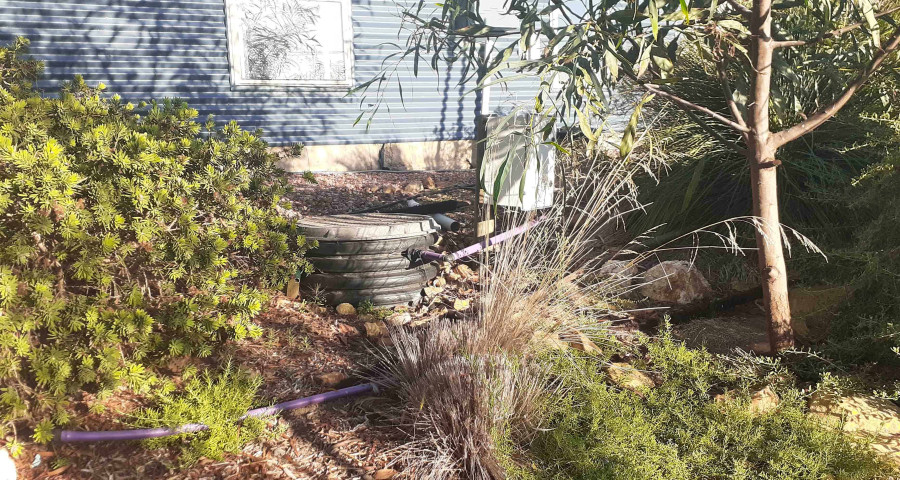
When we built our house (on a slab) we actually got all our grey water plumbed separately from the black water so that we could tap the grey water pipes once it left the slab (it joins the sewerage plumbing further down our block). After much research, I ended up purchasing a larger grey water system from WA (a ‘Greyflow Pro’ from Advanced Waste Water Systems) that can handle all our household grey water and is able to pump to various locations on our large sloping 1/3 acre block (ie. pumping uhphill). There are also smaller ‘plug and play’ systems which are easier to install. Now a substantial part of our mini food and ecological system (our yard!) is watered entirely by our recycled household water (19 fruit trees, three shade trees, two berry patches, and two native gardens), and it is immune to water restrictions or empty rainwater tanks.
This is very satisfying, but it was not cheap. The system I purchased today costs around $3000 to set up, plus I made a few mistakes in setup and maintenance, and not protecting the irrigation pipes adequately from our dogs (X@$&!). These mistakes have cost me a bit more money. Things are definitely harder when there is not a large body of experience easily to hand.

Things are definitely harder when there is not a large body of experience easily to hand.
Purchasing a grey water system is not easy either—you will have to do your own online research. There is no one selling or installing greywater systems locally in Bendigo. This is all because the market for grey water systems is still so small. Wider uptake of the technology is needed for systems to improve and for prices to fall.
This also means that you do have to learn how maintain and solve various problems that crop up with a grey water system. I am very happy with our system, but it has not been problem-free. Despite having ‘self-cleaning’ filters, I still have to manually clean them every six months and give the pipes a flush of clean water once a year. When it works well, you hardly know it is there, but that means you actively need to schedule check-up times to make sure it actually is working how you assume it is. The system we bought still had a few niggles, which have since been fixed by the developer (including a different circuit board), but which did create some headaches in the first couple of years.
Once again, this is basically a factor of a small market which is still in the very base stages of product development. Wider uptake will result in more product development and wider collective experience in installing and using greywater. I am happy to report that we now seem to have it all bedded down, and for the last five-six years the system has hummed along perfectly, doing exactly what we want.
My experience is that if you do go down the grey water path you need to consider that you are still in the pioneering phase of the knowledge and technology, which may involve its share of headaches and swearing, but which will ultimately be very satisfying and support a lot of productive greenery.
