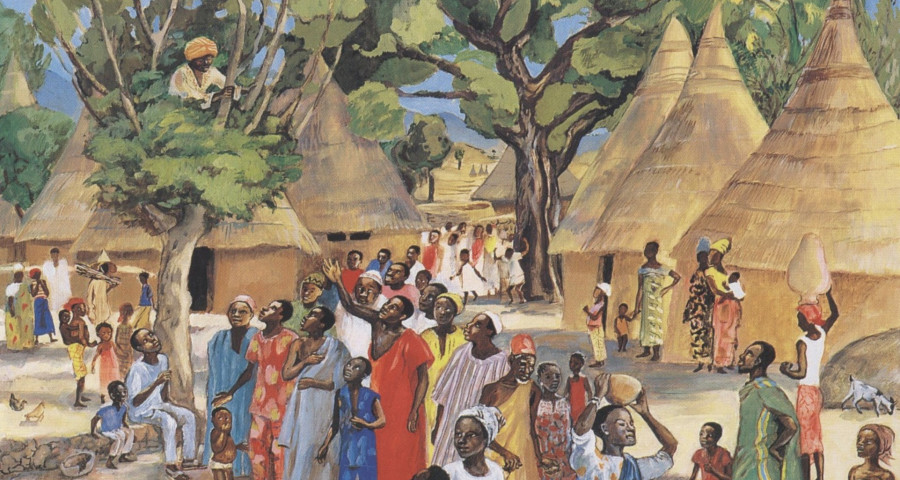
If you were among those who witnessed Jesus’ encounter with Zacchaeus, how would you have felt when Jesus, entering Jericho, approaches the ruling tribute collector? What memories and fears might their encounter have provoked? What hopes might it have inspired?
Two earlier articles published in Manna Matters (spring and autumn, 2025) examined how Luke 19:1–27 is often misread, and explored the world inhabited by Jesus, Zacchaeus, and all those who witnessed their encounter. In this article, I share a reading of 19:1–10 that resonates with the alternative tradition of interpretation previously introduced. Two further articles will share a reading of the story Jesus told in Jericho (19:11-27), and reflect on how Luke 19:1–27 might equip us to engage the pressing challenges of our day.
Rather than telling us about Jesus, the Gospels invite us to enter into their stories as if we were there, participating in events as they unfold. To read this way, we need to engage each scene as part of the wider narrative to which it belongs, appreciate the political, economic, social and cultural realities of first century Palestine, and learn to speak, think, and feel as surrogate members of that world.
Accompany me now as I imagine myself into the story. Along the way, we’ll switch between characters, recall the Jewish Scriptures or earlier episodes in Luke’s Gospel, and even step out of the story now and then. As we begin, recall the dynamics of tribute, land and debt relations, slavery and militarization in first-century Palestine, and the Scripture-inspired hopes and longings rekindled each Passover. Let’s put aside our previous encounters with Zacchaeus and experience the story as if for the first time.

Stepping into the text
We enter the gospel world as if among the twelve travelling with Jesus to Passover. He takes us aside. We’re going to Jerusalem where, Jesus says, he’ll be handed over to the Gentiles, mocked, insulted, spat upon, flogged, and killed (18:31–34). In one sense, that makes sense. Everyone knows that the scribes and Pharisees spell trouble for Jesus. Everyone knows that Herod wants to kill him. In another sense, we can’t imagine it happening. Would we have left everything to follow someone destined for humiliation, degradation, death?
Stepping out of the gospel world, I recall reading and re-reading the Gospel of Luke during its lectionary year. At first, the Gospel’s early chapters seemed to have a PG rating. Caesars, Herods, Roman procurators, and ruling priests are named (1:5; 2:1; 3:1–2), but not, or so I’d thought, in overtly ominous ways. With each re-reading I became aware of textual dimensions I’d not noticed before. The first shadows fall with ‘the sword’ to pierce Mary’s soul, the imprisonment of John, and the devil’s departure until ‘an opportune time.’ The sense of threat builds from there: the Nazareth congregation turns against Jesus; the scribes and Pharisees mutter; John is executed; the spectre of Herod remains; and Jesus speaks of the cost of discipleship, risk, danger, conflict, persecution, death. Belatedly, I realise that the Gospel’s references to rulers and hegemons are anything but innocuous. For most inhabitants of Galilee and Judea, their reigns signified hunger, dispossession, desperation, death. Mary’s song and Zechariah’s Spirit-inspired words defy a reality in which the powerful remain firmly enthroned, the rich enjoy the fruit of the land and the hungry are sent empty away. Augustus’s decree ‘that all the world be registered’ enforces the humiliating head tax and deeply resented rule of Rome. Angelic injunctions, ‘Do not be afraid,’ alert readers to real and ever-present danger.

With each re-reading I became aware of textual dimensions I’d not noticed before.
Re-entering the story as we approach Jericho, I remember the city’s past (Josh 2; 5:13–7:26): the prostitute’s house and scarlet thread; the ‘commander of the Lord’s army’ who, meeting Joshua outside Jericho, commanded him, like Moses, to remove his sandals: he stood on holy ground. Jericho’s walls fell at the people’s shout. Joshua declared: ‘Cursed before the Lord be anyone who tries to build this city—this Jericho!’
How hollow those words sound as the massive walls, extravagant palaces, and crowded thoroughfares of Roman Herodian Jericho come into view. Slaves, bent double, tend plantations on either side of the road. Other slaves, barely visible through the dust, toil on construction work, aqueducts, and storehouses. Long lines queue at toll stations. Now, as then, Israel is humiliated because some have broken faith, transgressed the covenant, taken devoted things, stolen, and acted deceitfully (Josh 7:1–12).
I hear Joshua’s challenge: ‘Choose this day whom you will serve.’ How the Scriptures taunt a defeated people! How can we keep the Sabbath, maintain the covenant and observe the fast the Lord chooses, loosing the bonds of injustice, releasing the thongs of every yoke, setting the oppressed free (Isa 58:6; 61:1-2)? We ourselves are bound, harnessed, captive, oppressed. It’s not as if we choose to serve the gods of Rome.
Entering Jericho, what does Jesus do? He goes straight up to the ruling tribute collector, Zacchaeus, the last person we want to be noticed by or seen with, and invites himself—and us!—to his house. We’ve followed Jesus long enough to expect him to challenge purity codes. But breaking bread with a ruling tribute collector? Unthinkable! Ruling tribute collectors inspire fear, resentment, and hatred for good reason. We all know families evicted from ancestral plots, children sold into bonded labour, wives and daughters forced into prostitution, fathers incarcerated because of tax/tribute/toll debts they cannot pay. To dine with Zacchaeus would be to eat the fruit of exploitation and oppression. My stomach revolts at the thought! Besides, hasn’t Jesus just said that he’ll be handed over to the Romans? Who better to do that than Zacchaeus, a Jew grown sleek on Jewish blood? If Jesus goes there, I will not follow. With all who see it, I mutter: ‘He’s gone in to stay with a sinful man.’

We’ve followed Jesus long enough to expect him to challenge purity codes. But breaking bread with a ruling tribute collector?
I remember stories Jesus told when the Pharisees and scribes objected to the company he kept: stories about a man who lost a sheep, a woman who lost a coin, a father who lost two sons; stories that focus on the finding, not the circumstances of being lost; stories that end with rejoicing. Now, as Zacchaeus welcomes Jesus, rejoicing, I wonder: what might Zacchaeus have lost and found? Is Jesus enacting the parable of the prodigal father? That story asked the scribes and Pharisees whether they, like the elder brother, resented the indiscriminate grace of God. But Zacchaeus did not squander his own inheritance; he seized our inheritance, squandering our lives and those of our children.
Zacchaeus tells Jesus, ‘See, half my possessions, Lord, I give to the poor; and if I have defrauded anything I give back fourfold.’ His possessions? If he has defrauded? That’s rich! In practice and in consequence, the entire Roman-Herodian tributary system contravenes our God-given Scriptures at every step. According to Rome, its ruling tribute collectors are entitled—expected—to accumulate possessions. The system, by design, gives more to those who already have and takes from those who have not what little they might otherwise retain. According to Moses and the prophets, the entire system is one that defrauds and plunders, murders and steals.
Jesus declares, ‘Today salvation has come to this house, because he too is a son of Abraham. For the Son of Humanity came to seek and to save that which is lost.’ What! If it was difficult for a ruler who thought he’d kept the commandments to enter the reign of God, how much moreso for a ruling tribute collector? Zacchaeus may have been born a son of Abraham but he sold that birthright years ago. As for seeking and saving the lost, the prophet envisioned thin, weak, hunted sheep being saved, not predatory sheep who ravaged the flock, trampled the pasture, muddied the waters, and pushed others aside. For thus said the Lord:
I myself will search for my sheep, and I will seek them out ... I will seek the lost, and I will bring back the strayed, and I will bind up the injured, and I will strengthen the weak, but the fat and the strong I will destroy. I will feed them with justice (Ezek 34:11, 16).
I want the ruling tribute collector fed justice, to be destroyed by justice of a relentless retributive kind. I want him to beg for mercy and have mercy denied.
My reading identity shifts and I become a resident of Jericho watching the exchange. The audacity of it! Jesus unilaterally welcomes Zacchaeus into our community. Doesn’t he know what Zacchaeus has done? He must know, everyone does. Zacchaeus promised to change… Even if he’s sincere, don’t expect us to welcome him rejoicing. He cannot restore land lost to tribute, years lost to prison, or children lost to hunger, disease, and bonded labour.
My reading identity shifts again: I am Zacchaeus. I shrink into the shadows when Jesus looks up, but his face and voice are friendly, unafraid. The crowd shifts restlessly as I scramble down. They don’t understand. How could they? I don’t understand myself. Everything changed the instant Jesus welcomed me and trusted me to welcome him. Without pausing to think, I say, ‘See, half my possessions, Lord, I give to the poor; and if I have defrauded anything I give back fourfold.’ I’ve never known such freedom, such space!
I look around at the crowd. Their faces do not reflect my joy. I cannot change the past and they will not forget it. A flash of metal catches my eye. The Romans! I couldn’t have staged a more public spectacle had I tried. I responded to Jesus neither calculating potential profits and losses nor weighing the consequences which, I’m beginning to realise, are not all good… I cannot regret what I’ve done. Yet, if both people and rulers reject me, what will become of me and mine?
Shocked out of the gospel world by Zacchaeus’s vulnerability, I remember Jesus’ story about a Pharisee and a tribute collector at prayer. The Pharisee’s ‘righteousness’ drives him away from others and drives them away from God. Leaving no room for grace and no space for redemption, he blocks the path to repentance. How can collaborators repent if their people reject them? My violence, like that of the Pharisee, perpetuates the violence of others.

How can collaborators repent if their people reject them? My violence, like that of the Pharisee, perpetuates the violence of others.
Grace affronts us. Blind to structural injustice, some blame the poor for their poverty. My inner Pharisee manifests differently. I shrink from diplomats who sell weapons to dictators; politicians who command slaughter in Iran, Ukraine, Gaza, Afghanistan; investors who profit from misery, the rape of forests, the manufacture of war; others who amass wealth unaware or indifferent to devastation wrought elsewhere. If God’s reign welcomes tycoons, tyrants, terrorists, and their retainers, I’m not sure I want to belong.
Even as I shrink from the company at God’s table, I recognise myself in those I revile. I cannot pray, ‘I thank you God that I am not like…’ because deep down I know that I am. Like the elder brother, the Pharisee and the rich ruler, I thought I’d observed the commandments, kept the covenant, and served God since my youth. But, like the younger brother, I squandered an inheritance. Like Zacchaeus, I squandered an inheritance not my own, betraying my brethren, the hungry, thirsty, sick, naked, indebted peoples of the world. Like the Pharisee, I indicted others of sin while blind to my own.
Sorrow overwhelms me as it did the rich ruler. What, I wonder, the cause of his sadness? Did he realise, perhaps for the first time, that he and his ancestors had not kept the covenant commandments? I hear the Lord’s promise-command spoken through Moses when renewing the covenant with people newly released from slavery in Egypt:
There will be no one in need among you, because the Lord is sure to bless you in the land that the Lord your God is giving you as a possession to occupy, if only you will obey the Lord your God by diligently observing the entire commandment that I command you today (Deut 15:4–5).
Had the ruler and his ancestors—had I and my ancestors—observed the entire commandment, we would not be rich while so many are poor. We have too much, have kept too much, have taken too much. Neither keeping Sabbath nor celebrating Jubilee, we ‘added house to house and joined field to field’: Our ‘hands are full of blood’ (Isa 1:15; 5:8). No wonder Jesus spoke of camels and needles: ‘How hard it is for the rich to enter the reign of God’.
I re-enter the world of the text as if a resident of Jericho listening to Jesus’ declaration (19:1–10). My mood swings from outrage to sober reflection to exhilaration. Jesus channels the words and vision of Ezekiel to evoke all the longings the Scriptures inspire. We are filled with expectation! Will the Lord now restore the realm to Israel? A rich ruler promised to change. Surely that’s a sign of God’s reign!
We step out of the story as Jesus begins to tell a story to the watching, listening crowd.
Had the ruler and his ancestors—had I and my ancestors—observed the entire commandment, we would not be rich while so many are poor. We have too much, have kept too much, have taken too much.
Reflecting on the experience
Did you feel out-of-step with my reading of Zacchaeus? When? Why? Return to Luke 19 and imagine yourself into the story as if the character(s) with whom you most naturally identify. How do you experience the story?
Rather than stopping halfway through the scene, continue reading to hear Jesus tell the story as if listening among the crowd. What do you make of it when listening as that character in that context?
Deborah Storie completed her doctoral thesis, An Adventure with Zacchaeus, in 2016. She lectures in New Testament at Whitley College, is Honorary Research Associate with the University of Divinity, and an accredited minister with the Baptist Union of Victoria.