
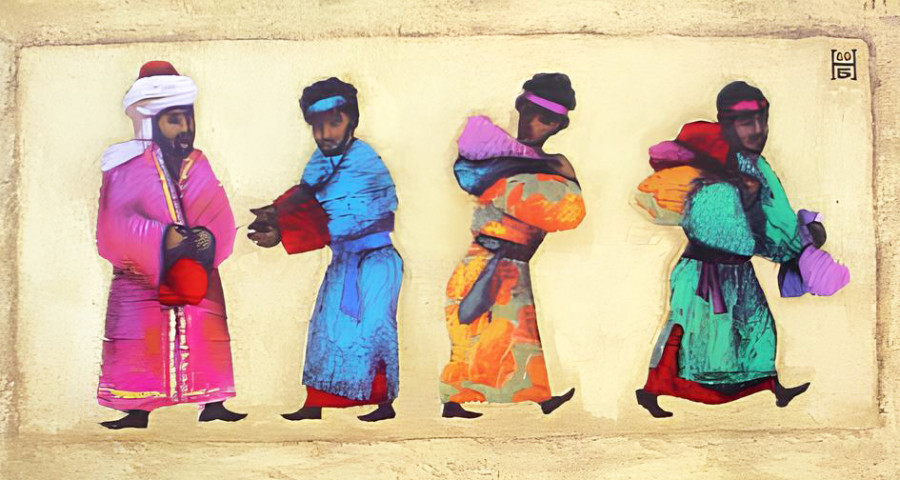
Jesus told a parable to those who, having witnessed his encounter with Jericho’s ruling tribute collector, expected the kingdom of God to appear immediately. Residents of Jericho and pilgrims en route to Passover—householders, slaves, servants and children; beggars and prostitutes; small traders and merchants; daily labourers, peasants and fisherfolk; Roman and Herodian soldiers; toll collectors of various kinds — had you been among them, what might you have made of this parable? How might you have sought to respond?
This, the fourth of five reflections on Luke 19:1–27, focuses on the parable of 19:11–27. Three previous reflections in Manna Matters examined how the passage is often misread; explored the world inhabited by Jesus, Zacchaeus, and the watching, listening crowd; and offered a reading of the first half of the scene, Luke 19:1–10. The final article in this series will ask how Luke 19:1–27 might inspire us to engage the pressing challenges of our day.
We begin with seven observations about Jesus’ parables, and seven notes about the parable told in Jericho. Next, I’ll draw on the work of other scholars to trace connections between the parable and other parts of Luke’s narrative which support realistic, rather than allegorical, interpretations. Finally, we return to Jericho to hear the parable as if among those to whom Jesus first told it.

To hear a parable aright, we need to respect the narrative, rhetorical, and historical contexts that the Gospels provide.
Approaching the text while minding the gap
The following seven observations about Jesus’ parables are, in one sense, obvious. They warrant repeating, however, because their interpretive significance is frequently overlooked.
- According to the Gospels of Matthew, Mark, and Luke, Jesus told many of his parables in response to a question, complaint, or situation. To hear a parable aright, we need to respect the narrative, rhetorical, and historical contexts that the Gospels provide.
- Jesus and the Gospel writers leave most parables uninterpreted, leaving Jesus’ original and Luke’s later audiences to wrestle with these parables themselves.
- Those few occasions on which Jesus does interpret a parable frustrate attempts to devise principles or rules to determine how other parables should be interpreted. Jesus interprets ‘the Parable of the Sower’ (Mark 4:3-20; Matt 13:3–23; Luke 8:5–15) allegorically: its elements function as metaphors for other things. In contrast, Jesus interprets the Parable of ‘the Good Samaritan’ (Luke 10:30–37) realistically and politically: ‘Go and do likewise.’
- Jesus addressed all his parables to groups of first-century people, the vast majority of whom were Jewish. He could, therefore, draw on Old Testament traditions and allude to common knowledge of his world, without spelling things out.
- The Old Testament prophets told parables that indicted Israel’s ruling elites, calling them back to God, and/or inspired their people to imagine and live toward a better God-given future. Would we not, therefore, expect Jesus, a prophet of Israel, to tell parables with similar intent?
- Jesus was not bound by any communicative principles or rules constructed by post-biblical commentators.
- When an interpretation of a parable conflicts with Jesus’ non-parabolic teaching, and/or with the Gospel writers’ portrayal of Jesus and his ministry, we should question that interpretation, return to the text, and seek to hear that parable afresh.
Additionally, the following observations about the parable of Luke 19:11–27 remind us to ‘mind the gap’ between its worlds and our own.
- The parable depicts a single reality in which power and violence, economics and politics, exploitation and resistance, are inextricably entwined. Receiving a realm from a far country (Rome) entailed receiving power to claim tribute and the obligation to maintain a steady flow of tribute to that far country in return. Direct military violence enforced indirect structural violence, enabling ruling elites and their slaves to take up what they didn’t deposit and reap what they didn’t sow.
- Following the death of Herod the Great, Rome appointed three of his sons (Archelaus, Antipas, and Philip) as tetrarchs. While the parable could be an abstract account of the reign of any vassal king, it most closely reflects the reign of Archelaus (4 BCE–6 CE) as described by the first-century Jewish historian Josephus (Antiquities 17.11).
- The subordinate characters in the parable are slaves (douloi), not ‘servants’ (a mistranslation favoured by the King James Bible and some other versions).
- A mina, the amount of silver their owner gives each slave, was worth approximately 200 denarii, as much as an average worker could hope to earn in year.
- Interest (tokos): the Torah explicitly forbids taking tokos (Exod 22:25; Lev 25:36–37; Deut 23:19). English versions often add qualifiers such as ‘excessive’ or ‘exorbitant’ that are not in the Hebrew and Greek manuscripts. The Psalms, Proverbs, and Prophets refer to taking tokos as a practice of the unrighteous/unjust (Psalm 55:11; Prov 28:8; Ezek 22:12) from which the righteous/just refrain (Psalm 15:5; Ezek 18:8, 13, 17), and sometimes use tokos as a synonym for oppression. Tokos appears twice in the Gospels: here and in Matthew 25:27.
- Neither Jesus nor the narrator explicitly affirms or condemns any of the parable protagonists, their words or actions. Do the slaveowner/king and obedient slaves act rightly, or the noncompliant slave and dissenting citizens? Such questions are left for those who hear or read the parable to discern.
- The economic violence (exploitative investment), physical violence (slaughtering the citizens), and historical violence (of enslavement) critiqued by the parable all happen off stage, but are not hidden from those who choose to remember, choose to see, and choose to hear.
The parable depicts a single reality in which power and violence, economics and politics, exploitation and resistance, are inextricably entwined.

The parable within Luke’s narrative
Growing numbers of biblical scholars identify striking parallels and contrasts between parable protagonists, characters in Luke’s narrative, and historical figures (in and beyond the narrative).
Narrative parallels and contrasts
|
||
|
Slaveowner/king of Lk 19:11-27 |
(Herodian) client kings |
Jesus |
|
Seeks a kingdom from a far country |
Sought kingdoms from Rome/ other imperial centres |
Refused Satan’s offer of ‘authority over all the kingdoms of the world’ |
|
Hated and opposed by citizens of the region |
Archelaus hated and opposed by Jewish delegation |
Opposed by ruling priests, Sanhedrin, leaders of the people |
|
Distributes money and authority to slaves |
Deployed slaves in many capacities |
Distributes healing power, bread and fish, authority over demons and diseases (to the twelve) |
|
Demands profits be turned (no questions asked); exploits his country folk |
Collected tribute; amassed and displayed immense wealth |
Instructs followers to share resources/give to whoever asks; friend of tribute collectors, sinners, prostitutes |
|
Appoints slaves to exert authority over cities |
Appointed slaves over cities (administration depended on and generated slavery) |
Appoints disciples to serve |
|
Feared by third slave |
Lord it over others; greatly feared |
Comes as one who serves; seeks and saves the lost |
|
Calls non-compliant slave ‘evil’ |
Herod Antipas did ‘evil’ (Luke 3:19) |
Offers forgiveness |
|
Has no qualms about collecting interest |
Presided over oppressive debt and land relations |
Instructs followers to forgive debts, restore equal relationships, lend expecting nothing in return |
|
Desires vengeance and commands dissidents be slaughtered in his presence |
Slaughtered dissidents, prophets, opponents, and potential opponents |
Teaches love of enemies; embodies way of peace; weeps over Jerusalem; dies forgiving enemies |
|
Affirms rich getting richer and poor getting poorer |
Reigns enriched the rich and impoverished the majority |
‘the first shall be last and the last shall be first’ |
|
Acts like a king |
Acted like kings |
Acts like a prophet |

Merrill Kitchen highlights further parallels between the parabolic slaveowner/king and the devil/Satan, the compliant slaves and Judas, and the non-compliant slave and Jesus. The slaveowner/king claims a kingdom, demands obedience, and promises rewards. The devil/Satan claims ‘all the kingdoms of the world,’ demands obedience, and promises rewards. The compliant slaves collaborate with the ruling system and achieve monetary gain through exploitative means. Judas collaborates with the ruling priests and achieves monetary gain by betraying Jesus. The noncompliant slave refuses to participate in exploitative power, confronts the slaveowner/king, is judged by his ‘own words,’ exposes injustice, and suffers the consequences. Jesus confronts the devil/Satan and the Sanhedrin, is judged by his ‘own words,’ exposes injustice, and suffers the consequences.
These narrative parallels and contrasts, together with the enslavement, impoverishment, and dispossession of the peasant population, the trajectory of Jesus’ other teaching, and the ethical thrust of the Hebrew Scriptures create an interpretive framework that renders positive interpretations of the slaveowner/king untenable. Even within the scene to which the parable belongs, the contrast between the economic vision Jesus affirms and the future the parabolic slaveowner/king pursues is stark: Jesus celebrates Zacchaeus’s declaration that he will give away half his possessions and pay back any he defrauds; the nobleman/king praises slaves who accumulate wealth and condemns the slave who does not.
The broader narrative context of Luke provides even stronger guidance. Consider, for example, chapters one through four. The angelic appearances and Spirit-inspired songs of the birth and infancy narratives call prevailing economic and political arrangements into question. Jesus’ wilderness contest with the devil alerts readers to the ongoing conflict between the powers of good and evil, between the reign of God and the rulers of this world. Reading Isaiah in his hometown synagogue, Jesus identifies with the promise and vision of Jubilee: good news for the poor, release for captives, freedom for the oppressed.

Returning to Jericho
Let’s walk with the disciples as Jesus enters Jericho and passes through. We watch Jesus approach the ruling tribute collector and, with all who see it, grumble. The rich ruler promises to change. Jesus declares salvation has come—today! What surer signs of God’s reign! Besides, Jesus is close to Jerusalem. But listen, he’s telling a story…
Our hearts sink when the slaveowner returns having taken the kingdom. We are not surprised when the first two slaves report large profits nor when they are deployed, still slaves, to wield authority over cities. These ‘good’ slaves do not benefit from their ‘faithful’ slaving. With each obedient act, they replicate the reign of terror and strengthen the system that enslaves us all. How did those slaves turn a profit? In what did they trade? Debt? Land? Sex? Slaves? We shudder at the human consequences turning such profits involves.
We are surprised when the third slave does not report, ‘Your mina has made two more.’ He does not feign subservience, veil his meaning, or flatter his owner. What slave would tell his owner that he, not his owner, decides what to do? What slave would openly declare his owner morally bankrupt? No slave who values their skin. Who dreams of defying those who dominate them? Who yearns to speak truth to power? Everyone we know. We admire the slave’s audacity and fear for his life. The slave admits he is afraid yet, with every reason to be afraid, does not bow to fear. His words cut through the fiction that minas make minas, that money works, unmasking the slaveowner/king’s malevolence and greed: ‘You take what you did not deposit; you reap what you did not sow’ (19:21).
Predictably, the slaveowner/king is angry. Assuming himself entitled to take what others deposited and reap what others sowed, he asks: ‘Why then did you not give my silver on the (money changer’s) table? Then, when I came, I could have collected it with interest.’ (19:22–23). We disciples are familiar with scriptural traditions about interest (tokos), justice, and injustice. According to Leviticus (25:35–37), taking tokos is antithetical to the fear of God: fear God or take interest, you cannot do both.
The slaveowner/king does not fear God but is afraid. The noncompliant slave demonstrates that even slaves cannot be forced to obey. Were other slaves to take his minas out of circulation, the slaveowner’s wealth would be scattered. Were nobody to obey his edicts, his opponents would not die. Were citizens, slaves and bystanders to unite, his rule would disintegrate. Addressing everyone and no-one, the slaveowner/king commands a slaughter (19:26–27). Does he no longer expect to be obeyed? The parable ends with the fate of the resisting citizens, the slaves, and the slaveowner/king unresolved.
What slave would openly declare his owner morally bankrupt? No slave who values their skin.
Jesus goes on ahead, climbing up to Jerusalem. We follow slowly, lost in our thoughts. The parable clearly recounts the wretched history of Herod Archelaus, his ambition, the cruelty of his rule… Might the slaveowner/king simultaneously represent all rulers of his ilk? The slaves are literal slaves… Might they also represent all those metaphorically enslaved to wealth, prestige, and power? Do the first two slaves represent Zacchaeus as he was, and the third Zacchaeus as he hopes to become? How will Zacchaeus, how will the people of Jericho, respond?
We are going to Jerusalem. Slaveowner-slaves as dangerous as Archelaus rule that city. Their orders are too often obeyed. What will the ruling priests, the leaders of the people, and the Romans do when the Son of Humanity prophesies against the city and against them?
I remember Isaiah: ‘Thus says the Lord, “Maintain justice, and do what is right, for soon my salvation will come, and my deliverance be revealed”’ (56:1). A rich ruler promised to give just about everything away but the infrastructure of empire remains very much intact. Yet, we all have influence, even slaves… Are we brave enough to use it? Could it be that when and how God’s reign arrives depends, at least in part, on us?
***
This reflection builds on the work of others who should be acknowledged.
- Merrill Kitchen, “The Parable of the Pounds” (1993).
- Luise Schottroff, The Parables of Jesus (2006).
- Elizabeth Dowling, Taking Away the Pound (2007).
- George Folarin, “The Parable of the Talents in the African Context” (2008).
- Sylvia Keesmaat and Brian Walsh, “Outside of a Small Circle of Friends” (2011).
- Justin Ukpong, “The Parable of the Talents” (2012).
Deborah Storie completed her doctoral thesis, An Adventure with Zacchaeus, in 2016. She lectures in New Testament at Whitley College, is Honorary Research Associate with the University of Divinity, and an accredited minister with the Baptist Union of Victoria.