
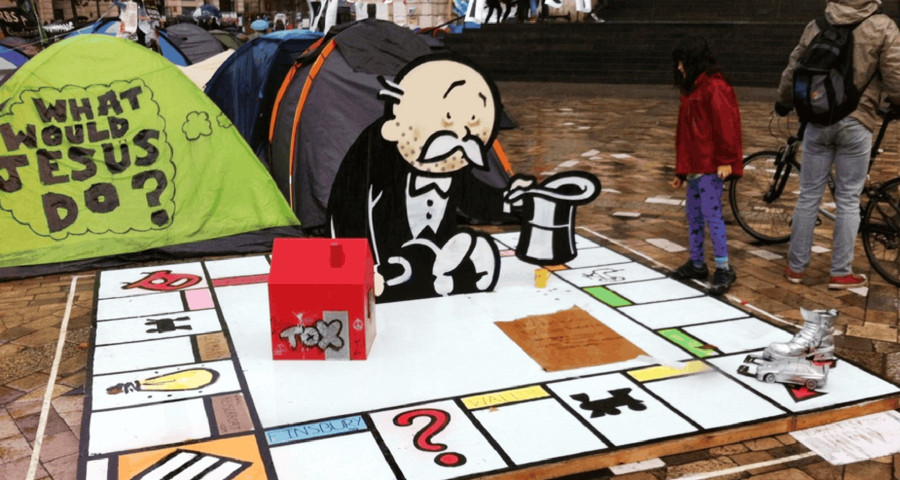
In 1903, a leftwing feminist called Lizzy Magie patented The Landlord’s Game. It had
two sets of rules: an anti-monopolist set in which all were rewarded when wealth was created, and a monopolist set in which the goal was to create monopolies and crush opponents… it was the monopolist rules that would later capture the public’s imagination (Mary Pilon, The Guardian).
Noting my children’s alternating responses of despair and gloating (and managing the ensuing squabbles) as we played Monopoly, I was struck with the realisation that I was demonstrating acceptance of a world in which ‘winners’ achieve economic success at the expense of ‘losers’. I decided to change the rules.
We played ‘Compassionate Monopoly’, in which unaffordable rent or fines (incurred by the fateful throw of the dice) could be paid by another. The impact was dramatic. Most notably, the game didn’t end. We put everyone’s money in labelled envelopes and held them over for the next round. Lo and behold, we had created a sustainable economy in which everyone kept moving around the board and no-one had anything to argue about. They lost interest. My adult kids now tease me about this, but it opened their eyes and their hearts to the impact of greed and inequity, and the possibilities of a community of kindness.
In our current Monopoly-like housing market, we are witnessing a staggering intergenerational transfer of wealth. There are winners and losers and this is not a game.
I must be clear-eyed about what is in my envelope. I am wealthy and the dice are weighted in my favour. As tail-end Baby Boomers, my husband and I won the birthday lottery. We have sailed up a rainbow of increasing national wealth, with free education for well-paid professions and free medical care. We have landed in a pot of gold, created by record-breaking property values and a superannuation system which protects our wealth and minimises our taxes. Many of us are property owners, investors, and landlords.
We’re familiar with the description of the early church in Acts 2 in which some believers sold properties to provide for others. They shared ‘everything in common’. Effectively networked communities can reduce their need for monetary exchange through sharing produce, goods, skills, and time but bills need paying and cars need petrol. In the spirit of ‘Compassionate Monopoly’, we can help one another through gifting, loans, or much-needed practical assistance. Generously, quietly, everyone gives as they are able, and we all keep moving around the board, giving thanks for God’s provision.

In our current Monopoly-like housing market ... There are winners and losers and this is not a game.
Reading through Leviticus, I was struck by the relevance of 25:35-38. As prices in the suburbs around our church rise inexorably, it’s getting harder for the non-home-owning members of our inner-urban church family to be able to remain ‘amongst us’. Communal mowers and trailers are one thing, but in a housing availability crisis, what about sharing the cost of real estate? What if, instead converting valuable properties into cash, we hold on to them and enable others to remain ‘amongst us’?
How might this look? Here are some ideas and real-life stories (de-identified). They are presented here, not as models that are being advocated, but as examples that more can be done than is generally recognised. The examples given here represent different approaches to the formality or informality of arrangements, and different levels of tolerance for risk. These matters need to be considered very carefully (see ‘Considering risk and legal advice’ below).
1) Help pay the rent
Some church communities include this kind of emergency giving as part of their local ministry. A family able to manage rent but stuck for bond money could be helped over the threshold by a financial gift or loan. If things are still tight, a regular supplementary contribution or a deposit in a particular account to be used in times of need might be considered.
2) Sharing the house? Or a ‘secondary dwelling’?
Some might be able to manage sharing their home (and expenses and tasks) with equanimity. A home with well-defined or separate spaces does make this easier.
Our granny flat:
Since 2006, our compact, comfortable one bedroom apartment has housed more people than I can remember. Family, friends, their friends and family, couch-surfers, missionaries on furlough, folks stuck here because of COVID, or from out of town with a loved-one in ICU have all stayed for a night or up to eighteen months. Some have paid (because they wanted to or because we needed them to take some responsibility) but most have not, as we didn’t need them to. Situations have occasionally been a little tense or messy, but the granny flat has undoubtedly been an extraordinary asset and a source of great blessing for us, as well as for our visitors.
However, you should be aware that, depending on what state you are in, and if there is money involved, hosting someone in a secondary dwelling might accidentally create an unwritten residential tenancy (in the eyes of the law) which may give the tenant certain rights to demand to stay longer, even if you initially had a verbal agreement for a certain period. It is worth checking laws about tenancy agreements as opposed to lodging agreements—the latter do not attract this problem.
Communal mowers and trailers are one thing, but in a housing availability crisis, what about sharing the cost of real estate?

3) Kingdom landlords
An investor in a position to buy a property outright or managing a modest loan may be able to offer lower rent and housing stability, matching rent to expenses rather than the market. A property might be purchased with the needs of a particular tenant in mind. Freedom to use the yard for growing food could be part of the money-saving deal.
An affordable, stable tenancy (M & kids):
In 2018, after two years of solo parenting, M was struggling to pay rent and had defaulted on a car loan. Her pastor advocated with the bank to reduce the outstanding loan, which was paid with gifted funds. M agreed to make regular contributions to a particular ministry to repay some of this debt. A church member invested in a spacious two-bedroom apartment with a small yard and offered it to M at below-market rent. Traumatised M was not a perfect tenant, but she paid her bills. After a seven-year period of stability, they moved on. The property was sold at a considerable profit.
4) Harness the possibilities of ‘tenants in common’ (TIC)
The chief benefit of this instrument lies in the legal preservation of the ownership rights of all parties. Depending on the jurisdiction, there may be three or more owners on the title. In contrast to the more commonly used ‘Joint Tenants’ arrangement, TIC ensures each receives their proportionate return when the property is sold or when one party pays the other(s) out. It makes possible shared purchases, shared mortgages, shared residency, or donor-owners and rental tenancies with buy-in.
Option A) Deposit as leg-up: 20% : 80%
Saving for a deposit in the present housing market is becoming impossible. With an investor ready to contribute a 20% deposit, the Resident ‘Tenant in Common’ may be able to take out a mortgage for the remainder without mortgage insurance. The parties will negotiate payment of ongoing property costs as per their equity and capacity and may sign an agreement to that effect.
Significant shares (H & friends):
In 2006, H found herself raising two small boys alone, so some friends helped her build a house. They were investors, she and her sons were the residents. The block of land and pre-designed home cost $320K (imagine!). H had some savings and took out a loan for the remainder of her one third share. Her friends paid cash for two thirds ownership. In lieu of rent, H paid all the bills. There was no end-date on the arrangement. No-one was sure what to expect, but that little family had stability in a convenient location near their support networks for eleven years. The house was formally valued for sale at $640K and everyone received their portions, doubled!
Option B: Cash purchase by investor. No loans. No interest.
A smaller start (the Brooks):
The Brooks had saved enough for a 5% portion as tenants in common, but they couldn’t manage a deposit or keep up with mortgage payments and other costs by themselves in the current market. Their co-investor paid cash to purchase 95% of the property and covered legals. As residents, the Brooks pay all bills, rates, and insurance. They cover smaller maintenance and home-improvement projects (up to $2000, contributing labour). Larger projects are co-funded. They plan to increase their equity through 5% lump sum transfers as they save. The shift in equity (as a proportion of market value) may then be adjusted through the titles office, for a small fee. The investors have committed to the arrangement for ten years, when everyone will receive back their equity (if the house is sold) or the Brooks may take out a mortgage and pay the investors their proportion of the value of the home at that time.
Investors purchase 100% - no bank interest, progressive buy-in (the Johnsons & Robertses):
In both cases below, the investors covered the purchase (in cash) while the residents cover property expenses.
The Johnsons had no funds to contribute after renting on one income and were still paying off a small personal loan. They put aside ‘rent’ in a savings account and even after paying the agreed bills, they soon managed to buy a much-needed ‘new’ second hand car and are now saving to make their first lump sum payment to their investors. They plan to activate formal inclusion as ‘tenants in common’ and gradually increase equity in what they hope is their ‘forever’ home.
The Robertses had some savings and decided to undertake a stepwise purchase of the property. Informally, they ‘bought’ an eighth of the property, in the form of a low (CPI) interest loan from the investor’s family company. They will pay this off as quickly as possible to minimise interest payments, then take on the next eighth. At the completion of the payment of each loan, the shift in TIC equity between the Robertses and their Investors will be recorded and signed. In this case, both parties are comfortable with the informal, trust-based documentation of this arrangement. However, for others, formal legal agreements may be more advisable.
Option C: Mortgage rescue/investment
Misty & Aunty Liz:
Misty was injured at work. When insurance payments ceased, Aunty Liz accessed superannuation funds to provide a fortnightly ‘top up’ to Misty’s Centrelink payments so she could stay on top of her bills and keep her flat. After ten months, Misty eased back into part-time employment but wasn’t out of the mortgage-stress woods. Liz offered to place a lump sum in Misty’s mortgage account for five years, halving the balance and reducing minimum payments and interest. Misty will pay off her temporarily-reduced mortgage as quickly as possible, also making an annual CPI-level interest payment to Liz. Misty can return the lump sum (and the top-up money) from her mortgage account and tackle the remaining loan. As Misty’s flat has doubled in value over the past three years, Misty and Liz are considering a shared equity agreement, in which case Misty could close the mortgage, owning 75% of an unexpectedly valuable property.

Considering risk and legal advice
It is important to be aware of the financial, legal, and relational risks involved in any sort of arrangements, and to act wisely in relation to the particularities of your situation. The courts are full of intra-family conflicts in which people have different interpretations of loans/gift/equity. The larger the sums of money involved, and the greater the complexity, the more important it is to clearly document what all parties are agreeing to. Seeking some legal and financial advice is often wise. This is not to say that informal arrangements are never appropriate; but you do need to be aware of the risks.
Here are some particular risks to consider:
- Inadvertently creating a type of legal relationship that is not the one intended (e.g. a gift instead of a loan, mortgage, co-ownership; a tenancy instead of a temporary stay).
- Conflict over who gets to decide whether equity is transferred at what times and how the exchange value will be calculated.
- Conflict over whether parties can buy each other out, sell their share of the equity to a third party or force the sale of the whole property.
- What any mortgagee’s rights would be, if there is to be one for either or both owner parties, e.g. could they repossess the entire property (and therefore boot out the residents), even if just one of the parties defaults?
- Other defaults or problems where a party can’t afford an expense they originally signed up for, if relevant.
Seeking some legal and financial advice is often wise.
***
In Coming Home, Jonathan observes that ‘investing in property can be either the most directly beneficial or the most directly exploitative form of investment.’ These examples illustrate ways in which those with resources might respond compassionately to the challenges presented by the housing crisis.
Economic interdependence can be an expression of the values of our community. Making any shared purchase requires sound advice, godly wisdom, funds, trust, a tolerance for risk, and a commitment by all involved to act in good faith. Houses are complex, high-stakes purchases and we could really use some Kingdom-minded accountants and solicitors to guide us through the legal and financial practicalities of this ‘next level’ of sharing.
Discernment is required and probing questions must be asked. Even if such purchases are possible, is it better to wait until prices fall? Will they? Is it kind to assist a young couple into a big mortgage? Will changes to town planning make more affordable ‘tiny homes’ (and land on which they may legally sit) preferable? What if the property bubble bursts? How will we construct wise and fair agreements to protect relationships as well as finances? If we lose money or are let down, are we prepared to take the hit, or ‘rather be wronged’ than take our siblings in Christ to court?
In the face of such uncertainty, can financially blessed ‘boomers’ hold the extraordinary financial gains of the past decade lightly, trust God, and boldly resolve to do good while we can? If we have the resources to help, Proverbs 3:27-28 exhorts us to turn our minds and hearts to creative solutions right now:
Do not withhold good from those to whom it is due,
when it is in your power to act.
Do not say to your neighbor,
“Come back tomorrow and I’ll give it to you”—
when you already have it with you.
Having assisted their own freshly paired fledglings into dovecotes (the last in early 2020), home-loving Columba Livia Domestica (aka The Common Homing Pigeon) and her finance-savvy Co-Pilot soon became aware of others who were struggling to afford safe and stable nesting places. Blessed with well-feathered circumstances and keen to find ways to navigate this crisis, they have been able to guide others to suitable roosts of their own. Although flying under the radar, Columba felt that sharing experiences and ideas might inspire others to work together to creatively provide soft landings for other flight-weary members of the flock.
***
* With many thanks to Jono Barnett for further input and advice.