
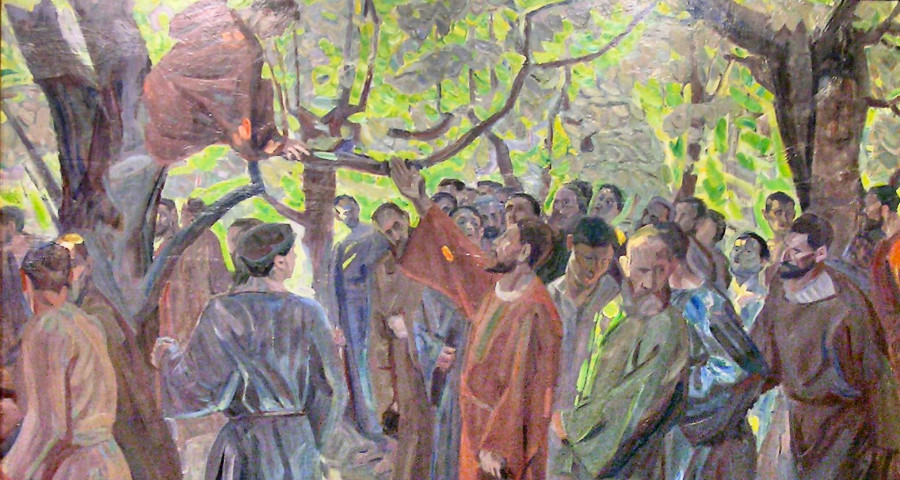
As followers of Jesus, we seek to live toward the future for which he taught us to pray, a future with God’s reign come, God’s will done, on earth as in heaven. How we interpret the Bible shapes how we live, and that changes the world—in line with God’s promised future or otherwise. How might the story of Zacchaeus inspire and equip us to live in ways that anticipate, however imperfectly, the reign of God?
This is the question we explore in this, the fifth and final reflection on Luke 19:1–27. The first reflection in the series contrasted two interpretive traditions. Most scholarly and lay interpreters of Luke 19:1–10 habitually focus on questions of individual repentance and salvation, overlooking the social, economic and political dimensions of the text and of the historical world behind it, and allegorise the parable of 19:11–27 in ways that implicitly affirm hierarches of power and privilege and endorse further wealth accumulation by the already wealthy. A growing minority of interpreters re-contextualise and de-individualise Jesus’ encounter with the ruling tribute collector to hear the parable as an abstract yet realistic depiction of the worlds in which it was first told and heard. The second reflection of the series explored the world inhabited by Jesus, Zacchaeus, and the watching, listening crowd, and considered the significance of the story’s geographical and temporal moorings. The third and fourth invited you to accompany me as I imagined myself into the story of 19:1–10 as if participating in events as they unfolded, and asked you to imagine hearing the parable in narrative, historical, and canonical contexts as if among those travelling to Passover with Jesus.

How might the story of Zacchaeus inspire and equip us to live in ways that anticipate the reign of God?


‘Minding the gap’
How, then, might Luke 19:1 –27 equip and motivate us to live toward the reign of God? As Wolfgang Stegmann observes in Jesus and the Hope of the Poor:
Any translation of the concrete faith-in-action of biblical times into our concrete situation today, will require a recognition on our part of analogous relationships between biblical times and our own.
Cultivating a critical awareness of the historical worlds from which the text emerged, and in which we now receive and respond to it, better equips us to draw appropriate analogies between the situations and contexts reflected in the text and those of our own world.
When you compare the world of Jesus, the disciples, Zacchaeus, and all those with whom they interacted (the world behind the text), and the world in which we receive and respond to this story (our world in front of the text), what similarities and differences strike you most forcibly? The New Testament world was characterised by inequality, imperial rule and tribute, slavery, conflictual land and debt relations, militarisation, and resistance. Do somewhat analogous structures and systems operate today? How are you located in contemporary hierarchies of power and privilege? How am I enmeshed in economic and political, social and ecological relationships? Do our socio-economic locations, life experiences, and cultural assumptions affect how we receive and respond to Luke 19:1–27? Should they influence how we read and respond?
Socio-economic status, and the life experiences and assumptions that accompany it, profoundly influence biblical interpretation, perhaps more than any of the other ‘gaps’ that separate us from the biblical world. Social location influences interpretation but does not dictate it. Awareness of our economic status, and the power and privilege that accompany it, alerts us to choices we might otherwise overlook and to biases of which we might otherwise be unaware. It also equips us to consider the this-world consequences of our interpretations, and, hence, to respond in ways that align, however imperfectly, with the reign of God. Rabbi Jonathan Sacks puts it well:
[Biblical interpretation] is not so much a question of declaring some interpretations wrong and others right . . . What is important to us is what interpretations are responsible for people in our location in our times, and which word we choose to live by today. The ethical question concerns not so much ‘Who is right and who is wrong?’ as ‘What sort of lives our Bible readings engender? How do our lives change the lives of others – including future generations?’ (The Dignity of Difference)
All the New Testament and much of the Old emerged from communities of faith that contended with hostile power-laden contexts. For these communities, daily bread was not assured, debt was inescapable, and unjust trial commonplace. Ill-served by prevailing political and economic arrangements, biblical communities of faith longed and prayed for change.
Although the geographies, mechanisms, and complexions of imperialism have changed and changed again over the centuries since then, today’s world is still marked by inequality (see Figure 1), imperial rule and tribute of various kinds, modern forms of slavery, conflictual land and debt relations, militarisation and resistance. Nationally and internationally, resources are extracted from poor regions, and unwanted surpluses, weapons, and pollution are exported to them (see Figure 2). Entrenched disparities of wealth and power are stabilized by managing the exclusion of the majority through trade, migration and labour laws; investment and business; debt and other forms of obligation; information technologies and the media; and military, humanitarian, and development interventions. The overall consequence of today’s global power differentials, like that of the early Roman Empire, is to redistribute resources upwards to a wealthy minority (see Figure 2). The empires of this world still give more to ‘the haves’ and take up from ‘the have-nots’ what little they might otherwise have retained.

How am I, how are you, enmeshed in local and global hierarchies of power and privilege? Eight out of ten Australians number among the world’s 10% most wealthy people. The one in five Australians outside this top global income bracket are likely to be Indigenous Australians, non-English speakers, and/or people living with disability or struggling with addiction. Yet most Australians within the top global income bracket feel anything but rich. Within Australia, 50% of households hold only 10% of Australian wealth; the wealthiest 10% of households own nearly half; the top 1% control 14% of Australian wealth (ABS data). Although ecological footprint rankings vary from year to year, Australia’s per capita footprint is among the heaviest in the world. According to World Wildlife Fund, if everyone lived like Australians, over three planets would be needed to support the global population. This is no accident. Global economic systems normalise destructive commercial-industrial practices and promote irresponsible levels of consumption. The pursuit of economic growth, advertising, and broader cultural shifts produce and normalise ever-escalating levels of consumption and waste production. We passed the ecological break-even point sometime in the 1970s.
What about the church? While Australian Christians cross socio-economic spectrums, National Church Life Surveys consistently report that church members tend to have higher educational qualifications, hold a disproportionate number of influential positions in government, public services, and private institutions, and are more likely to own their homes than non-church going Australians.
It is difficult not to admit that I have more in common with first century governing and retainer classes than with peasants, artisans, vagrants or slaves. In all likelihood, the socio-economic locations of other Manna Matters readers are not dissimilar. Jesus and his disciples lived in the shadow of empire. In today’s world, the empire serves us.

Jesus and his disciples lived in the shadow of empire. In today’s world, the empire serves us.
Interpretive approaches and their this-world consequences
Most interpreters of Luke 19:1–27 disrupt the integrity of the narrative (separating the parable from the rhetorical context to which it belongs); approach the text through cultural assumptions shaped by power and privilege (money makes money, slaves should obey their masters); reduce things with concrete meaning to allegories or abstractions for other things (rendering the story less vivid, exciting, and emotionally engaging); and soften the imperial, political, and economic dimensions and power dynamics of the text (overlooking the function of tribute and the reality of slavery, exploitative investment, and imperial rule). Cumulatively, these interpretive habits insulate readers from the injustices and violences portrayed in the text and operative in the historical world from which it emerged and, thereby, prevent them from drawing analogies between that world and our own.
If we read the parable of Luke 19:11–27 within an imperial framework, we hear and see everything being done properly: a sovereign acting as entitled, ‘good and faithful’ slaves serving well, a ‘wicked’ (cowardly, lazy, stupid) slave being enlightened and chastened by his master. Read through cultural lenses honed by an oppressive society’s understanding of justice, the parable sounds a warning to serve the empire and its vassals whole-heartedly. As masters, we see nothing wrong with taking what we didn’t deposit and reaping what we didn’t sow. As retainers, we appreciate the master’s praise and welcome the opportunity for greater authority. This approach affirms prevailing political and economic arrangements, however inadequate, and is unlikely to inspire transformative action in the world. But that is not the only way to read.
The clue to interpreting Luke 19:1–27 resides in retaining the Gospel’s narrative integrity and respecting our own innate narrative competence. This requires us to read the text (rather than an interpretation or a fragment of it), attend to the historical context it reflects and from which it arose, and participate in the story—through our imaginations—as surrogate members of the Gospel world. Reading this way, we learn to listen for scriptural echoes and attend to relationships between discourse and power: who speaks and who is silent? Who says what to whom in front of whom and in what context? What is not said or written at all? Pushing back into the story, we begin to recall the histories of appropriation and dispossession behind events and relationships, and gradually reshape our intuitive judgments about what is probable and what is not, what things might mean and what they might not. We begin to read between the lines.
Like the prophets before him, Jesus used parables, poetic visions, and other forms of figurative communication to expose realities that powerholders concealed and generate new possibilities the powerful denied. ‘Jesus’ way of teaching through parables,’ as Walter Brueggeman understands it,
[was] a pastoral act of prophetic imagination in which he invited his community of listeners out beyond the visible realities of Roman law and the ways in which Jewish law had grown restrictive in his time. . . [H]e tells parables consistent with the rabbinic tradition, but his parables serve to conjure alternative social realities. They are specific, but they are open-ended. The listener, when the story is ended, is not instructed and does not know what to do. The stories intend to characterize an alternative society which he calls ‘kingdom of God’ but the stories do not offer blue-prints, budgets or programs. They only tease the listeners to begin to turn loose of the givens of the day and to live toward a new social possibility. (Hopeful Imagination)
Like many of Jesus’ parables, Luke 19:12–27 presents socio-political and economic systems that engender, depend on, and perpetuate violence as a problem audiences can identify, question, resist, and—potentially—transform.
If we hear the parable of Luke 19:1–27 within a prophetic Gospel framework—‘good news for the poor!’— we see an astute critique of imperial rule and the structures and practices it promoted and upon which it depended: tribute, slavery, exploitative investment, and their consequences. We also glimpse new and hopeful possibilities. The noncompliant slave is not timid, indolent, dim-witted, or wicked. He courageously takes the mina out of circulation, seizing an opportunity to shape a future aligned with God’s reign. Slaves are not extensions of their masters; slaves do not necessarily serve their masters’ purposes. Masters are not necessarily slaves to their power and wealth; masters can give back to those they’ve defrauded. Slaves can speak the truth to their masters. Masters can listen and change. Zacchaeus (slave of the imperial system, master of slaves) breaks with the system and enacts new possibilities. The parable’s noncompliant slave does likewise. Even if the dissident citizens are slaughtered, the prophetic voice is not silenced. Blood cries out from the earth—Ishmael, God hears.
***
The parable Jesus told in Jericho confronted those enslaved by power—rulers, retainers, priests, landlords, and tribute collectors as well as slaves—with pressing questions: where does your allegiance lie? What vision do you pursue? Whose purposes do you serve? Retold today, the parable critiques somewhat analogous hierarchies and the exploitative structures and practices they promote and upon which they depend.
Where does your allegiance lie? What vision do you pursue? Whose purposes do you serve?
Our economic and ecological violence is rarely intentional or overt. Faceless systems and structures take for us what we didn’t deposit and reap for us what we didn’t sow. What human and ecological realities do our superannuation and other investment statements conceal? If we push back behind the products and services we use, what histories of appropriation, dispossession, and coercion might we find? The land upon which we live is stolen, as were its children. Will we continue to steal other lands and the futures of other children?
The parable reminds us that, however we are enmeshed in contemporary structures and systems, we each have influence and agency. It confronts us with pressing questions. How do we use our influence, in whose service, and to what ends? Collectively and individually, will we break loose from the givens of the day and live toward a future with God’s reign come, God’s will done, on earth as in heaven?
Deborah Storie completed her doctoral thesis, An Adventure with Zacchaeus, on Luke 19:1–27. She lectures in New Testament at Whitley College, is Honorary Research Associate with the University of Divinity, and an ordained minister with the Baptist Union of Victoria.