
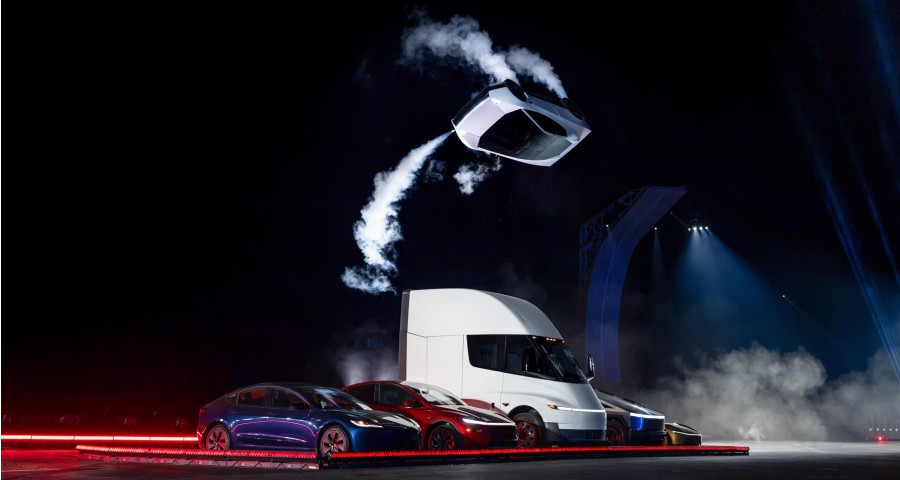
It’s late evening, I have allowed myself to become distracted watching Elon Musk’s latest Tesla presentation to find out if their new Roadster car actually flies.
Answer: no… But it sure can jump and, in the words of Buzz Lightyear, ‘fall with style.’
Having settled that, it’s time for a quick prayer before bed. As my wife Andi (who has no interest in flying cars) prays, I notice my mind drift and something softly descends on me—a feeling, more than a thought.
‘How quaint,’ it seems to say, ‘praying… when you just saw a car do a kickflip.’
My conscious mind may disown it, but I think this feeling taps into a more general atmosphere of wonder at our feats of cutting-edge science and technology. We can do amazing things—many of them much more amazing (and more worthwhile) than marketing stunts with rocket cars.
It’s this same kind of feeling which led the late biologist E. O. Wilson, with whom we begun this series, to dismiss the relevance of passages like Job 38-41 for people like us: Job might be impressed by God’s knowledge of the world and stand in awe of its many marvels, but thanks to scientific progress we can now peer behind the curtain.
Instead of dumb wonder at the unknown, Wilson encourages us in the ‘true Promethean spirit of science’ which he says will ‘liberate man by giving him knowledge and some measure of dominion over the physical environment.’
Elon Musk certainly has this spirit, describing his vision of a ‘glorious exciting future’ like this earlier in the year in his Terafab launch speech:
We want to be a civilisation that expands to the galaxy with spaceships where anyone can go anywhere they want at any time—that would be epic—and have a city on the Moon, cities on Mars, populate the solar system and send spaceships to other star systems. That sounds like the best possible future.
Wilson and Musk are only particularly striking examples of a broader shift in outlook that has occurred over the last 250 years. Our world today is one in which our many scientific discoveries and technological accomplishments have wrought seismic changes in our imagination and our sense of our place and potential in the cosmos. What kind of story are we living in, and who are we in it? Why pray to a God whose mysteries seem to have been solved?
This is the final article in a series reflecting on the ancient book of Job in an age of eco-crisis and modern technology. Last time, we considered humanity’s need for limits in the face of the seemingly limitless promise of technology. In this one, we will try to gets to grips with what’s changed and what hasn’t since Job was written. We’ll examine the character of our technological society and suggest some ways we might respond to the challenges we face.
Knowledge, power, and wonder
More than a few scientists and theologians may scoff at the arrogance of statements like those of Wilson or Musk. In a reflection on Job 38, for example, Bible scholar Richard Bauckham suggests ‘our knowledge of the universe has expanded vastly since Job’s time, but nevertheless the difference is comparatively superficial.’ The more we discover, he says, the more we discover how much we don’t know. The answer is to cultivate ‘cosmic humility’.
Fair enough, but I feel Bauckham’s response misses the point slightly. Arguing that many unknowns remain does little to address the fact that what we do know (or think we know) has nonetheless delivered us immense power in and over the world through the fields of applied science. The absence of a single unified Theory of Everything in physics has not stopped us inventing the internal combustion engine, plastics, supersonic aircraft, nuclear energy, synthetic crops, quantum computers, generative AI, and nanomaterials. It hasn’t stopped the engineers at Tesla making a car that can park upside down and go half the speed of sound.
Regardless of the patchy state of our theoretical knowledge, for most of us it is the experience of our technological power which plays the decisive role in forming our picture of ourselves in relation to the rest of creation. Justified or not, Wilson’s confident scientism and Musk’s galactic ambitions were simply not available to the imagination of someone in Job’s time: they are products of our world today, and this difference is far from superficial.

For most of us it is the experience of our technological power which plays the decisive role in forming our picture of ourselves in relation to the rest of creation.
Wonder what, how, or that?
To be sure, many of God’s questions to Job remain unanswerable: who has ever been shown the gates of death (38:17) or given orders to the morning (38:12)? Nevertheless, we need to come at things a bit differently.
The first step is to notice is that God’s speeches in chapters 38-41 not only challenge the extent of Job’s knowledge and his power, they are also an invitation to behold God’s heavens and God’s earth—to contemplate, dwell upon, and allow ourselves to be steeped in their majesty and beauty. The fact that this is poetry is important: we will miss some of the purpose of these passages if we go looking just for information.

Does the hawk take flight by your wisdom
and spread its wings toward the south?
Does the eagle soar at your command
and build its nest on high?
(Job 39:26-27)
In her book Consecrating Science, Lisa Sideris, a scholar of the intersection of science, religion, and environmentalism, advocates for a form of wonder which is rooted in encounter with the world instead of relying simply on awe of the as-yet unknown. She promotes an approach she describes as ‘less an orientation to what something is or how it came about than that the thing is.’ We might say this is wonder at the sheer fact of something, instead of the facts about it: a disposition which foregrounds its very being, instead of our comprehension and control (or not) of it. Moreover, she says, there are aspects of the world we miss when we concern ourselves only with what the physical sciences can disclose to us, while the very success of the scientific method tempts us to subtly re-direct wonder away from the world itself and instead focus on us: techno-scientific humanity, the ones who have figured much of it out! How marvellous are we!
Importantly, Sideris argues we need not denigrate scientific endeavour in seeking an orientation to the cosmos which treats ‘mystery’ as something more and other than just a puzzle to be solved. The key, she says, to this richer and more stable mode of wonder ‘lies in grasping the somewhat elusive claim that reality is mystery; the two are not in conflict.’ Prosaically, we might say that no matter how much knowledge we accumulate, there always remains a surplus, not of knowledge per se, but—how shall we say it?—of reality itself, which evades accounting. Attending in wonder to life’s irreducibility, Sideris maintains, is core to exchanging a utilitarian and possessive attitude to the Earth for one marked by true humility and receptivity.
Returning to Job 38-41, we can understand God’s speeches as partly an invitation to this kind of wonder: Come, appraise the world afresh with me Job: is it not more than you have made of it? Will you grant that it has its own life and its own ways beyond any affair of yours? Will you accept it—can you love it—and me? Can you make your home here, amid all else I have made, on these terms, or will you insist upon your own?
Reality on our terms or God’s? That is the question. Perhaps the great danger of technology is that it seems to offer us a chance to re-write the terms and conditions policy of human life and, increasingly, the power to shape the conditions of all life on Earth too. As we saw last time, this does not necessarily make technology evil, only perilous. While fundamental to our lives, it is anything but neutral.
Reality on our terms or God’s? That is the question.
Life in the technological society
Though technology has always been with us, the great theorist of technology, Jacques Ellul, saw that with modernity we entered into a new relationship with it. Ellul actually speaks chiefly not of ‘technology’ but rather the character of rational efficacy which technology embodies, something he calls ‘technique’. At one point, he describes technique this way:
the translation into action of man’s concern to master things by means of reason, to account for what is subconscious, make quantitative what is qualitative, make clear and precise the outlines of nature, take hold of chaos and put it in order. (The Technological Society)
The overriding quest of technique is for ‘the one best way’—that is, the most efficient way—of achieving some end, given what is possible in a particular time and place. This ethos is the same whether we are discussing methods of advertising, politics, surgery, military campaigning, or manufacturing a car. Effectiveness is the essence of technique, and this makes it very hard to argue with: considered technically, certain methods are simply better for attaining the desired results – something as plain as the fact that the number four is greater than three.
While technique has always played a role in human affairs, Ellul argues that in recent centuries, beginning in Western Europe, the cultural and moral frameworks of societies which kept technique in check began to break down. By our time, the technical mindset—which emphasises means over ends, objects over subjects, utility and efficiency over all other considerations—has well and truly taken over. Whether in economics, government, education, or almost any other sphere, says Ellul, the argument for optimisation according to rational efficiency is now the only real game in town. If you’ve ever felt like just a cog in the corporate machine, Ellul says this is why; yet CEOs and heads of government are just as beholden—if not more beholden—to the imperatives of technique than those working below them.
This is because in modern technological societies, all problems to be solved must be solved technically, and technique admits of only one best solution. Whatever ‘choice’ we might think we have between various methods therefore evaporates upon technical analysis. Efficiency and effectiveness set the rules of the game: if you want to win (or even stay competitive), you have to play by the rules. Go against technique with something else—i.e. something less effective—and you will, by definition, lose. The options we feel are available, as individuals and as societies, are thus constrained by technical necessity.
Taken to its furthest extent, Ellul argues technique is intolerant to all limits set by any sense of the sacred: ‘mystery’ is denied outright and daily proven to be merely what has not yet been technicized. Likewise, the technical ethos is impatient with nature, advocating ‘the entire remaking of life and its framework because they have been badly made.’ Having desacralised all that was previously revered, technique itself can even become the object of religious devotion where it promises power in our weakness, control amid the chaos, and predictability in place of chance and risk: a kind of technological salvation.
As a theologian, Ellul sees the spiritual implications of all this: left to itself, technique will subordinate all things in creation—whether humans, animals, or the earth itself—to its logic, trivialising our freedom and eroding our ability to conceive of things outside its frame of reference. Meanwhile, it persuades us that the benefits of ‘progress’ are worth the costs. Seeing only means while remaining blind to ends, unbridled technique wreaks havoc in our world through a constant stream of the unintended consequences of its shortsightedness. The ‘technicians’—those who practise technique—will say the only way out is through: we will save the world by applying more of the very thing which has endangered it. Some argue that this is true with respect to our present ecological crises and, in some cases at least, it is hard to see an alternative (e.g. the challenge of removing PFAS— ‘forever chemicals’—from the environment). Technique begets more technique.
Seeing only means while remaining blind to ends, unbridled technique wreaks havoc in our world through a constant stream of the unintended consequences of its shortsightedness.

What do we do?
There is a price to be paid for fabricating around us a society which is as artificial and mechanised as our own, and this is that we can exist in it only on condition that we adapt ourselves to it. This is our punishment. (Philip Sherrard)
Ellul helps us recognise that the shift in our technological capabilities between the time Job was written and our own is not just one of quantity but of quality. It is in large part due to the dramatically increased power over the material world this shift has delivered into our hands that we are facing ecological challenges of a complexity and scale unthinkable by the author of Job. What does faithful and obedient Christian life in 21st century technological society look like in the light of these realities? Below are a few steps we might take.
Embrace husbandry
Every creature inescapably lives from and within the mysterious pattern of creation—what farmer and essayist Wendell Berry calls ‘the Great Economy.’ However, our unique combination of moral freedom and a technological nature means human beings may choose to act as if they do not live from mystery. So, Berry says, ‘If humans choose to live in the Great Economy on its terms, then they must live in harmony with it, maintaining it in trust and learning to consider the lives of wild creatures.’ Put simply, this means replacing mere technical mastery with something richer: husbandry. Berry finds a paradigmatic example of this in the practice of soil maintenance and cultivation. Its opposite, soil loss,
is a problem that embarrasses all our technological pretensions. […] It is lost a little at a time over millions of acres by the careless acts of millions of people. It cannot be saved by heroic feats of gigantic technology but only by small acts and restraints, conditioned by small fidelities, skills, and desires. ('Conservation and Local Economy')
Truly speaking we cannot make soil, or any substitute for it. To some extent we can build it, but ‘we can do so only by assenting to, preserving, and perhaps collaborating in its own processes.’ Yet humanity’s inability to create topsoil is not a problem to be solved: rather, looking for such a solution is a blind alley. We already have the ‘solution’ we need, but it requires a different way of participating in the material world which embraces creaturely limits. This does not mean disavowing all technology—which is impossible—or even all modern technology (though this may be the calling of some), but it does mean waking up to our relationship to our tools.
Cultivate wonder
I wrote in the first article in this series about the deep familiarity the Job poet has with the non-human creation, something expressed in a constant stream of images and metaphor. For most of us, cultivating attentive wonder toward the world outside ourselves will likely begin with going outside (though visual art, poetry, nature films, etc. can all play a role). This is often easier said than done: according to the government, Australians spend about 90% of our time indoors! As I sit here writing this on a screen, inside, with the sounds of cars and planes outside my window, I am reminded of the words of Richard Louv: ‘we cannot love what we do not know, and we cannot know what we do not see. Or hear. Or sense.’
Taking our lead from God’s specific and personal attention demonstrated in Job 38-41, we might also do our best to resist caring for creation only in the abstract. Even under the banner of ‘environmentalism,’ it is possible to care for no particular environment or any real place. If we’re not careful, we risk reducing both the ‘environmental problem’ and its ‘solution’ to a simplistic calculus:
Motorway through downland: bad. Wind power station on downland: good. Container port wiping out estuary mudflats: bad. Renewable hydropower barrage wiping out estuary mudflats: good. Destruction minus carbon equals sustainability. (Paul Kingsnorth)
The opposite of the abstract is the particular. Which places—gardens, parklands, wildlife corridors, coastlines, etc.—do we know and care for personally? We cannot entirely deputise such care to others, nor can a love for God’s wondrous world mean much without incarnation.

‘We cannot love what we do not know, and we cannot know what we do not see. Or hear. Or sense.’ (Richard Louv)
Seek freedom together, through restraint
Finally, we need to give serious attention to our own use of and dependency on various forms of technology, as well as our absorption and acceptance of an instrumentalising outlook. Practically, this requires drawing lines—establishing limits on our adoption and use of technology. Where exactly these lines ought to be drawn is, in my view, secondary to the act of drawing them. If the impulse of our age is to ignore or dismantle limits, then simply creating and observing any sort of limit (even if it seems arbitrary) is a counter-cultural act. It’s also something much more easily done together: a ‘digital Sabbath’, for example, is much more fun when observed with others.
Depending on how things go in coming years, there may come a time (we might already be there) when more formal ‘communities of refusal’ become something we may consider joining or starting. This doesn’t have to look like the Amish, but there is real wisdom in recognising that the technological conditions of our lives profoundly affect the character of our communities and the practice of our discipleship.
This is also not a binary either/or: we don’t have to contemplate a full-on technological monasticism to take real action. What lines could we draw as churches about how we engage with technology? What values do we want to embrace and embody? Which do we want to reject? Importantly, the goal of such lines-in-the-sand is not restriction as a good in itself, but rather saying ‘no’ to some things so that our ‘yes’ may be given more fully to others. If we don’t, we will inevitably be drawn along in the tide of the times: saying ‘no’ is one tool for preserving our freedom; it is one way we can make a stand.
***
The goal of this series has been to explore the relationship between humanity, creation, and technology, using the ancient poetry of Job as our guide. We have seen how Job affirms an inherent goodness and likeness shared by all that God has made, yet the rational and technological nature of humanity means our role is easily abused. If our use of technology to manipulate the material world reveals our spiritual orientation, then our present crisis in ecology urgently demonstrates our need for a spiritual renewal: a new way of being human in God’s world. Of course, the source of that renewal must be sought beyond the pages of Job, in the New Testament’s proclamation of a new human— a Second Adam—whose work is to reconcile all things.
Seen in their ecological and theological context, the dangerous power of modern technology urgently demands we consider anew the mystery of creation, as well as God’s radical challenge to human knowledge and power. Can we observe creaturely limits for the sake of ourselves as well as the rest of creation, amid the ever-expanding horizons of human control over matter? Much depends on our answer to this question.